In popular culture, scientific discovery is often portrayed in “Eureka!” moments of sudden realization: a lightbulb moment, coming sometimes by accident. But in real life—and in Penn Medicine’s rich history as a scientific innovator for more than 250 years—scientific breakthroughs can never truly be distilled down to a single, “ah-ha” moment. They’re the result of years of hard work, perseverance, and determination to keep going, despite repeated, often discouraging, barriers and setbacks.
“Research is [like taking], four, or six, or eight steps back, and then a little stumble forward,” said Drew Weissman, MD, PhD, the Roberts Family Professor of Vaccine Research. “You keep doing that over and over and somehow, rarely, you can get to the top of the step.”
For Weissman and his research partner, Katalin Karikó, PhD, an adjunct professor of Neurosurgery, that persistence—documented in thousands of news stories across the globe—led to the mRNA technology that enabled two lifesaving COVID-19 vaccines, earning the duo numerous accolades, including the highest scientific honor, the 2023 Nobel Prize in Medicine.
Weissman and Karikó were also the 2022 recipients of the Breakthrough Prize in Life Sciences, the world’s largest science awards, popularly known as the “Oscars of Science.” Founded in 2012 by a group of web and tech luminaries including Google co-founder Sergey Brin and Meta CEO Mark Zuckerberg, the Breakthrough Prizes recognize “the world’s top scientists working in the fundamental sciences—the disciplines that ask the biggest questions and find the deepest explanations.” With six total winners, including four from the Perelman School of Medicine (PSOM), Penn stands alongside Harvard and MIT as the institutions whose researchers have been honored with the most Breakthrough Prizes.
Virginia M.–Y. Lee, PhD, the John H. Ware 3rd Professor in Alzheimer’s Research, was awarded the Prize in 2020 for discovering how different forms of misfolded proteins can move from cell to cell and lead to neurodegenerative disease progression. Carl June, MD, the Richard W. Vague Professor in Immunotherapy, is the most recent recipient and will be recognized at a star-studded red-carpet event in April for pioneering the development of CAR T cell therapy, which programs patients’ own immune cells to fight their cancer.
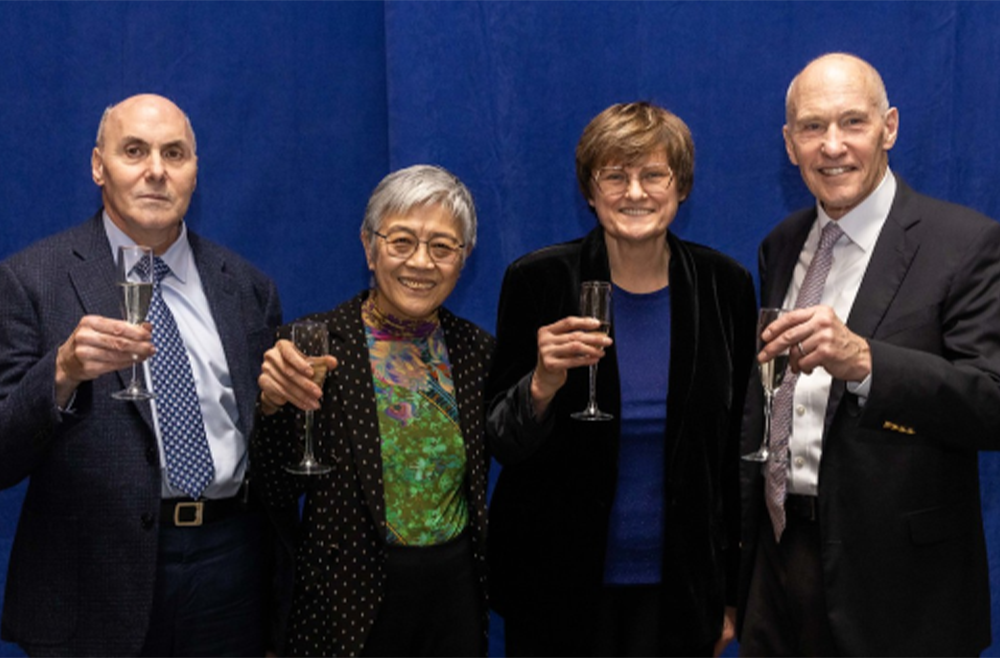
The four PSOM Breakthrough Prize recipients were honored on Tuesday, Feb. 13, 2024, when a new large-scale installation was unveiled in the lobby of the Biomedical Research Building to celebrate each laurate and their life-changing discoveries. During a light-hearted panel discussion, the honorees shared how a clear purpose, dogged determination, and a good sense of humor enabled their momentum forward.
Persistence despite false starts, mistakes, and failure
None of the Breakthrough Prize recipients claim a straightforward path to success or a singular moment of brilliance that made the world sit up and take notice. In fact, many have doubted their ideas, which together now make up some of medicine’s most transformative advances in history. And while they’re able to laugh with ease about their early days now, their willingness to transparently acknowledge the hardships and struggles that go into making truly world-changing scientific discoveries offers realistic, not rose-colored, inspiration for the next generation of scientists.
For Lee, a career in science wasn’t the original plan. She began her studies at the Royal Academy of Music in England, intending to become a piano teacher. Once there, Lee said she realized she lacked the talent and desire for a career in music.
“[I thought], I like science, so maybe I should focus on science. I actually never really did well in science either, except that I just kept going,” Lee recalled with a chuckle. Eventually, she earned her doctoral degree and met John Q. Trojanowski, her eventual partner in research and love, with whom she ran a laboratory at Penn for four decades.
Karikó’s career hardships and resolve—including immigrating from communist Hungary to the United States with her young daughter and husband to pursue science—have made her an inspiration to young scientists struggling to gain advance their ideas amidst a competitive grant funding landscape. Despite spending decades trying to prove the therapeutic potential of mRNA, Karikó and Weissman’s research went largely ignored by the broader scientific community until the COVID-19 pandemic arrived, and with it, the need for a quickly scalable vaccine strategy to protect people from the deadly virus.
Karikó shared a sense of disbelief as she reflected on the sharp 180-degree recognition of her work over the last five years, encouraging those struggling to gain a foothold in their career: “If you’re having difficulties in your position, cheer up, because the future might be bright!”
For June, the closest thing resembling a “eureka” moment came from a mistake, a lapse in protocol in his lab: failure to eliminate a research mouse at the end of an experiment that involved studying CAR T cell therapy to assess immune response to the approach. Instead of simply correcting the mistake and moving on, he took the opportunity to learn from it. When June’s team realized that the mouse was still carrying viable CAR T cells, six months after they were delivered, they knew it was the first proof that they were working on a living drug with the potential to cure cancer.
That same instinct for curiosity is what continues to drive June as a scientist and mentor to the dozens of graduate and undergraduate students who have studied in his lab over the years. Every Wednesday, he shared, his lab members meet to discuss what’s happening in their research projects. Without fail, “something unexpected” always comes up—a result of an experiment or an observation that wasn’t predicted along the path of well-crafted experiments.
Any time an unexpected finding is shared, June says he feels incredibly lucky to be the second person, as principal investigator, to learn about it, but even more excited for his trainees, who get to experience the joy and wonder of seeing something new for the first time. As a scientist, June explains, that’s “the adrenaline and the dopamine that keeps you going back.”
These breakthroughs are only the beginning
June is still going back—actively running his lab and mentoring young scientists—and all four scientists remain passionately engaged with the future of their respective fields. Not content to rest on their laurels or remain content with already impacting millions of people around the world, they see their foundational discoveries as merely the beginning.
Thanks to Lee’s work, drugs to slow the progression of Alzheimer’s disease are already making their way into the clinic, with more in phase III clinical trials that could save older adults from the worst impacts of dementia and other neurodegenerative diseases. CAR T cell therapy is rapidly being tested across the cancer landscape and in autoimmune diseases. June sees a future where, thanks to collaborations with Interim PSOM Dean Jon Epstein, MD, CAR T cell therapy is applied to more common conditions, like cardiac disease. And Weissman hopes to find himself in Sub-Saharan Africa within the next decade, “with a cooler full” of mRNA-based therapy to treat patients with sickle cell disease.
As the Penn Medicine community continues to focus on making breathtaking discoveries and putting them to work, the breakthroughs of tomorrow could very well come from those inspired by walking in the footsteps of these celebrated scientists paving the way.