
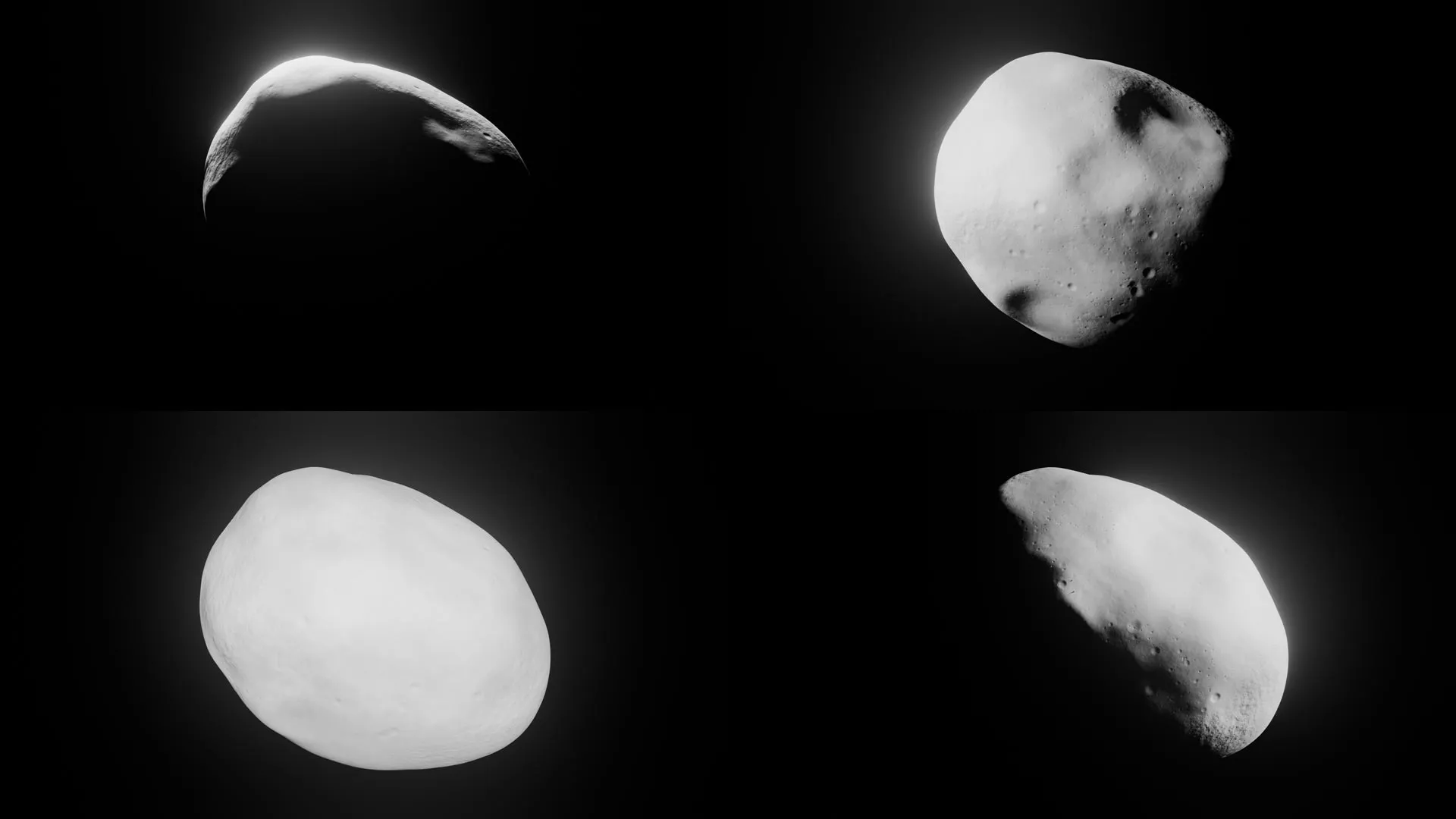
Approximately 4.6 billion years ago our solar system formed from a huge disk of gas and dust orbiting our Sun. The asteroids we see today are some of the most complete artifacts of this formation left for us to observe, like the screws, offcuts, and other debris leftover at a construction site. Scientists can study these floating time capsules and examine their composition, shape, and surface makeup to infer what our solar system was like when it was born.
Asteroids are organized by researchers into categories based on similar characteristics, and a recent paper published in The Planetary Science Journal, led by IPAC scientist Joe Masiero, shares evidence that two distinct types of asteroids may have actually shared the same harsh past.
“Asteroids offer us the chance to look at what was going on in the early solar system like a freeze frame of the conditions that existed when the first solid objects formed,” said Masiero.
Using data from Caltech’s Palomar Observatory, Masiero’s research focuses on two categories of asteroids, one that is metal-rich and another made of a mix of silicates and other materials. While they have completely different compositions, the two share a unique dusty layer of a material made of both iron and sulfur, called troilite.
“Troilite is very uncommon, so we can use it as a fingerprint that links these two different types of objects to each other,” said Masiero.
It’s just a phase
Asteroids are separated into different classes based on the spectrum of light reflected off of their surface, denoted by letters such as M, K, C, and more. The spectra can show the presence of carbon, silicates, or metals in the regolith, or surface dirt, of the asteroid.
In this study, Masiero looked at M- and K-type asteroids. M-types are metal-rich, while K-types are composed of silicates and other materials and thought to be linked to an ancient giant collision between asteroids. About 95 percent of Earth’s crust and mantle are made up of silicates.
But the same materials on asteroids can appear differently depending on the shape of the asteroid, the size of the regolith (dust, pebbles, boulders), and the phase angle of the asteroid relative to the Sun.
Asteroids in our solar system are constantly moving: orbiting the Sun and rotating on their own axis, and because of this, just like how the Moon has phases, asteroids do too. The phase angle is the angle between the Sun, asteroid, and the Earth.
“While spectra indicate that there are different minerals on the surface of these objects, we’re trying to figure out how different these bodies truly are,” said Masiero. “We want to wind the clock back to when these formed and what conditions they formed under in the early solar system.”
Same asteroids; new techniques
Masiero turned to polarization, particularly in the near-infrared, as a method for studying asteroids. By measuring the polarization of the reflected light on the M- and K-type asteroids he was studying, Masiero shows that the two previously discrete asteroid spectral classes may actually be linked through their surface composition.
Polarization describes the direction of the waves that make up light, similar to how brightness is a measurement of how many photons there are, or how color is a measurement of the wavelength. Different surface minerals have different polarization responses when they reflect light, the same way they can have different colors.
Changes in an asteroid’s phase angle can significantly affect polarization, and this response is a result of the variety of materials on the surface. Masiero used the way the degree of polarization changes with phase angle to investigate the makeup of the asteroids’ surfaces. This technique can probe the composition even when the minerals don’t show any color or spectral response.
“Polarization gives us insight into the minerals in the asteroids that we can’t get from just how well the asteroid reflects sunlight, or what the reflected light’s spectrum looks like,” said Masiero. “Polarization gives you a third axis to ask questions about the surface mineralogy that’s independent of brightness or spectral information.”
Masiero used the WIRC+Pol instrument at Caltech’s Palomar Observatory in the mountains above San Diego, California.
“Palomar is such a fabulous facility. It’s great to interact with the observing team there; the telescope operators and the support astronomers really are helpful in making sure you can get the best data possible,” said Masiero. “For the infrared polarization data I needed, there is no other instrument that can get nearly as deep. This is an asset unique to Palomar.”
When the dust settles
After the polarization studies, Masiero concludes that both M- and K-type asteroids share the same dusty surface of troilite, an iron sulfide material.
Masiero argues that the evidence of troilite is a sign that these two types of asteroids actually came from similar types of original larger objects that later broke apart to create the asteroids we see today.
The different overall compositions of the asteroids can be linked to the different layers within the large original objects. Like how Earth has a core, mantle, and crust made of different materials, these types of asteroids could originate from the different layers.
The troilite dust may have been abundant on an original object before breaking up, or it could have been a cloud of dust that covered everything after it broke up, but its roots are still unknown.
“You can’t go and rip the Earth open to see what is inside, but you can look at asteroids — the leftover bits and pieces, the unused components from solar system formation — and use them to see how our planets were built,” said Masiero.
IPAC at Caltech is a science and data center for astrophysics and planetary sciences. Palomar Observatory is owned and operated by Caltech, and administered by Caltech Optical Observatories.