
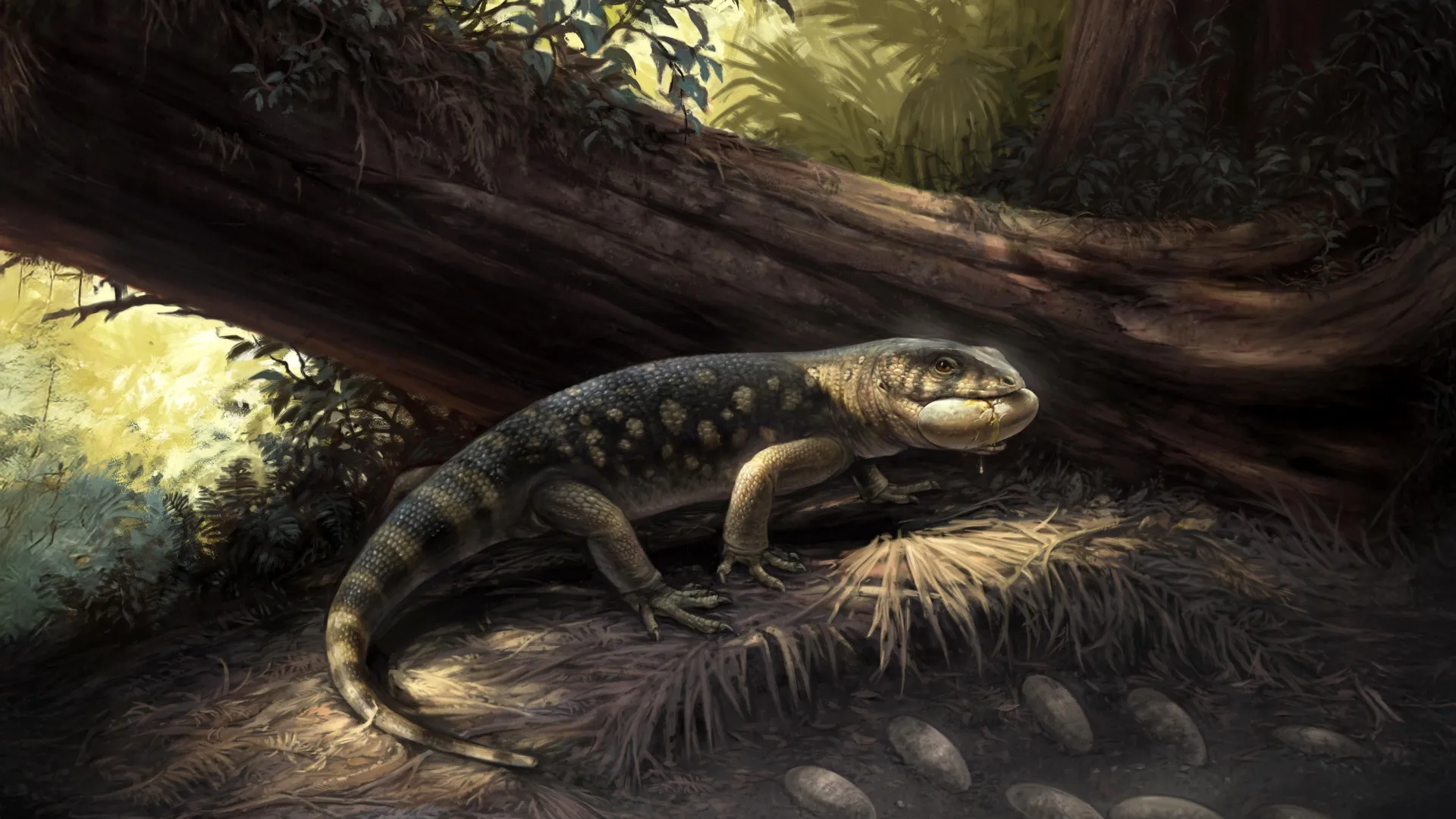
A newly discovered, raccoon-sized armored monstersaurian from the Grand Staircase-Escalante National Monument in Southern Utah, United States, reveals a surprising diversity of large lizards at the pinnacle of the age of dinosaurs. Named for the goblin prince from J.R.R. Tolkien’s “The Hobbit,” the new species Bolg amondol also illuminates the sometimes-murky path that life traveled between ancient continents.
“I opened this jar of bones labeled ‘lizard’ at the Natural History Museum of Utah, and was like, oh wow, there’s a fragmentary skeleton here,” said lead author Hank Woolley from the Natural History Museum of Los Angeles County’s Dinosaur Institute. “We know very little about large-bodied lizards from the Kaiparowits Formation in Grand Staircase-Escalante National Monument in Utah, so I knew this was significant right away.”
Published on June 17, 2025 in the journal Royal Society Open Science, the collaborative research led by the Dinosaur Institute and the Natural History Museum of Utah (NHMU) reveals hidden treasures awaiting future paleontologists in the bowels of museum fossil collections, and the vast potential of paleontological heritage preserved in Grand Staircase-Escalante National Monument and other public lands.
“Discovering a new species of lizard that is an ancestor of modern Gila monsters is pretty cool in and of itself, but what’s particularly exciting is what it tells us about the unique 76-million-year-old ecosystem it lived in,” said co-author Randy Irmis, associate professor at the University of Utah and curator of paleontology at NHMU. “The fact that Bolgco-existed with several other large lizard species indicates that this was a stable and productive ecosystem where these animals were taking advantage of a wide variety of prey and different micro-habitats.”
A Middle Earth-inspired moniker
Bolg represents an evolutionary lineage that sprouted within a group of large-bodied lizards called monstersaurs, that still roam the deserts from which Bolg was recovered. Woolley knew that a new species of monstersaur called for an appropriate name from an iconic monster creator, Tolkien.
“Bolg is a great sounding name. It’s a goblin prince from ‘The Hobbit,’ and I think of these lizards as goblin-like, especially looking at their skulls,” said Woolley. He used the fictional Tolkien Elvish language Sindarin to craft the species epithet. “Amon” means “mound,” and “dol” means “head,” a reference to the mound-like osteoderms found on Bolg’s and other monstersaur’s skulls. “Mound-headed Bolg” would fit right in with the goblins — and it’s revealing quite a bit about monstersaurs.
Hidden gems in collection drawers
The Bolg amondol discovery highlights the likelihood that more large-bodied lizards existed during the Late Cretaceous Period than previously thought. Bolg, along with other fossils from the Kaiparowits Formation, demonstrate at least three types of predatory lizards lived in the Late Cretaceous sub-tropical floodplains of what is now Southern Utah. Additionally, this find shows that unexplored diversity is waiting to be dug up both in the field and in paleontology collections.
“Bolg is a great example of the importance of natural history museum collections,” Irmis said. “Although we knew the specimen was significant when it was discovered back in 2005, it took a specialist in lizard evolution like Hank to truly recognize its scientific importance and take on the task of researching and scientifically describing this new species.”
The researchers identified the new species from tiny pieces of skull, limbs, girdles, vertebrae and bony armor called osteoderms. Most fossil lizards from the age of dinosaurs are even scrappier — often just single, isolated bones or teeth — so despite their fragmentary nature, the parts of Bolg‘s skeleton that survived contain a stunning amount of information.
“That means more characteristics are available for us to assess and compare to similar-looking lizards. Importantly, we can use those characteristics to understand this animal’s evolutionary relationships and test hypotheses about where it fits on the lizard tree of life,” Woolley said.
Stairway to monstersaurs
The monstersauria are characterized by their large size and distinctive features, such as sharp, spire-like teeth and pitted, polygonal armor attached to their skulls. They have a roughly 100-million-year history, but their fossil record is largely incomplete, making the discoverya big deal for understanding these charismatic lizards. Bolg would have been a bit of a monster to our eyes.
“Three feet tip to tail, maybe even bigger than that, depending on the length of the tail and torso,” said Woolley. “So, by modern lizard standards they’re a very large animal, similar in size to a Savannah monitor lizard; something that you wouldn’t want to mess around with.”
Bolg’s closest known relative hails from the other side of the planet in the Gobi Desert of Asia. Though dinosaurs have long been known to have traveled between the once-connected continents of the Late Cretaceous Period, Bolg reveals that smaller animals also made the trek, suggesting there were common patterns of biogeography across terrestrial vertebrates during this time.
The rocks where Bolg was discovered — the Kaiparowits Formation of Grand Staircase-Escalante National Monument — have emerged as a paleontological hotspot over the past 25 years, producing one of the most astounding dinosaur-dominated records in North America. Discoveries like this underscore the importance of preserving public lands in the Western U.S. for science and research.
“The exceptional record of big lizards from Grand Staircase-Escalante National Monument may prove to be a normal part of dinosaur-dominated ecosystems from North America, filling key roles as smaller predators hunting down eggs and small animals in the forests of Laramidia,” said co-author Joe Sertich from the Smithsonian Tropical Research Institute and Colorado State University.
This story is edited from the original by Tyler Hayden, science communication specialist, Natural History Museum of Los Angeles County.
Other authors include Keegan Melstrom, University of Central Oklahoma and Nathan Smith, Natural History Museum of Los Angeles County, Dinosaur Institute. Field collection of the specimens described in this study was conducted under paleontological permits issued by the Bureau of Land Management (BLM). This study was funded by the BLM, National Science Foundation award 2205564, the Natural History Museum of Los Angeles Dinosaur Institute and the University of Utah.