
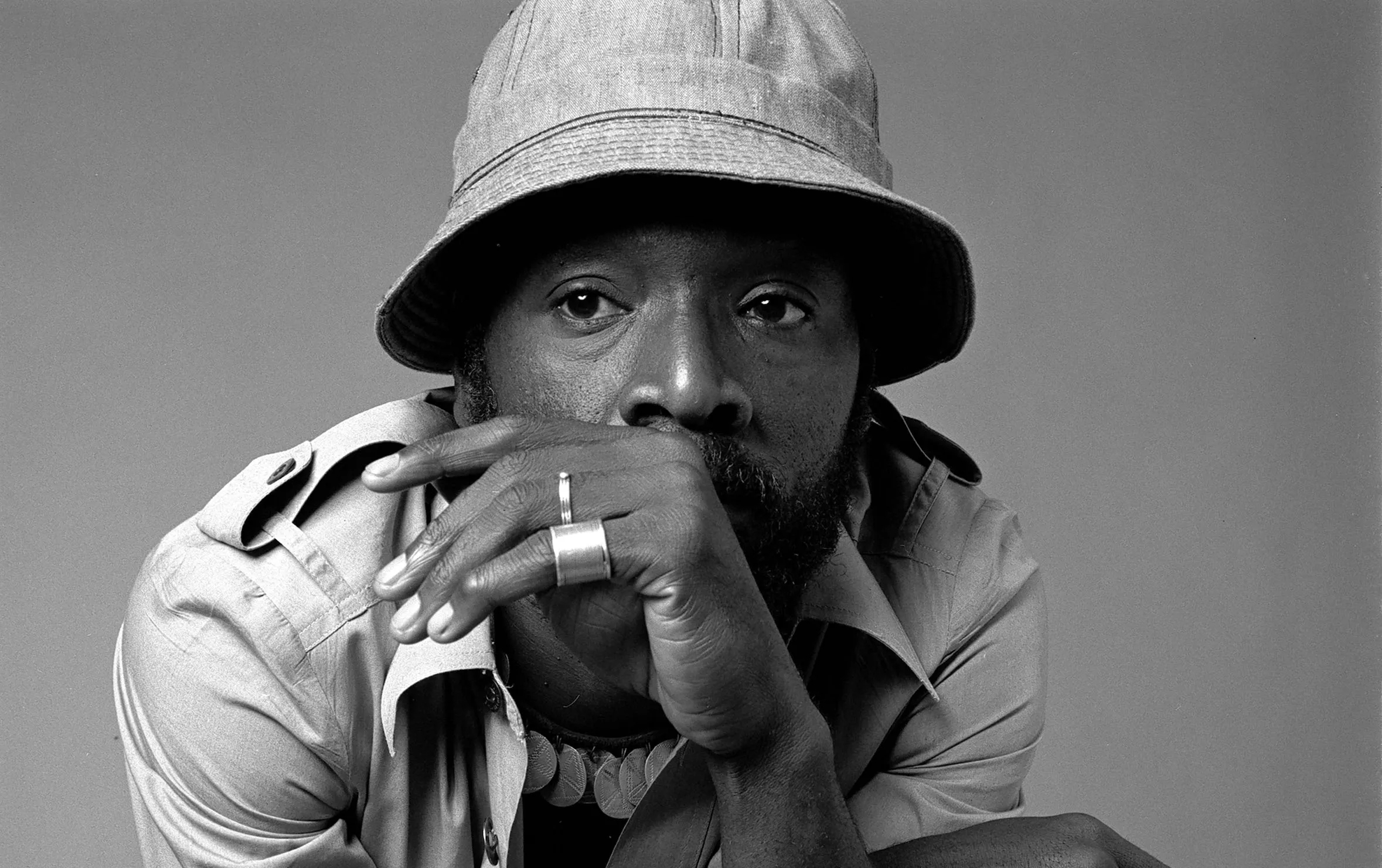
Raymond Saunders, whose collage-based paintings and installation works grappled with the complexities of lived experience, racial identity, and broader sociopolitical structures, died on July 19 in Oakland, California. He was 90 years old. The news of his death was announced in a joint statement from Casemore, Andrew Kreps, and David Zwirner galleries, which co-represented the artist. The cause was aspiration pneumonia, the New York Times reported.
Described as a cult-like figure in the arts community of the San Francisco Bay Area, where he had lived and worked since the early 1960s, Saunders is best known for his assemblage-style blackboard surfaces bearing white chalk and chalk-like notations, smears of vibrant paint, and accumulated found ephemera. His mixed-media work is known to have influenced artists including Jean-Michel Basquiat and has often drawn comparisons to Robert Rauschenberg’s Combines (1954–64) paintings.

Raymond Saunders, Andrew Kreps, and David Zwirner)
Saunders’s death came just days after the closing of his first major museum retrospective, Raymond Saunders: Flowers from a Black Garden, held at the Carnegie Museum of Art in his hometown of Pittsburgh. The show brought him long overdue recognition in a mainstream art world that has often overlooked or lumped together artists based on their shared identity, a pattern Saunders railed against in his landmark 1967 pamphlet “Black Is a Color.” In the printed essay, published in response to an article by Ishmael Reed about the Black Arts Movement, Saunders criticized the pigeonholing of Black artists, arguing that they should not feel obligated to center their art and their successes on their race. “Can’t we get clear of these degrading limitations, and recognize the wider reality of art, where color is the means and not the end?” Saunders wrote.


While rejecting oversimplistic characterizations of identity, the artist often produced work that explored the subject of race and his own daily observations as a means to understand himself and the world around him. Pieces like “Beauty in Darkness” (1993–99) juxtaposed segregationist signage, business posters, religious imagery, pages from children’s books, and paintbrushes, disparate elements that nevertheless cohere in the composition. Other works referenced prominent Black artists and cultural figures like “Charlie Parker [formerly Bird]” (1977) and “Malcolm X: Talking Pictures” (1994); in “Untitled (Bird Lives)” (1995), a chalk-drawn symbolic Basquiat crown is featured among illustrations referencing Jazz musicians Thelonious Monk, Miles Davis, and Dizzy Gillespie.
“I’m American. I’m Black. I’m a painter. So all those things enter into what it is that becomes what I present,” Saunders said in a 1994 interview.

Born on October 28, 1934 in Homestead, Pennsylvania, Saunders was raised with his three sisters by a single mother. After his family moved to the nearby city of Pittsburgh, he began taking art classes through the Carnegie Museum’s Saturday morning youth program. There, he met one of his earliest mentors, public school arts educator Joseph C. Fitzpatrick, who helped him earn a scholarship to the Pennsylvania Academy of Fine Arts. While there, he also studied at the Barnes Foundation through the University of Pennsylvania.
Like Fitzpatrick’s other mentees, who included Andy Warhol and Mel Bochner, Saunders went on to study at the Carnegie Institute of Technology (now Carnegie-Mellon University), where he received a Bachelor of Fine Arts degree in 1960. He then moved to California and earned a Master of Fine Arts degree from the California College of Arts and Crafts (now California College of the Arts) in 1961.
Saunders relocated briefly to New York City, where he had his debut solo exhibition in 1966 at Terry Dintenfass’s East 67th Street gallery, known for representing several Black artists, including Jacob Lawrence and Richard Hunt, during a period when the city’s galleries showed primarily White artists.

The artist described his process for making art as “ongoing,” in part because of his reluctance to move on from a work: “I have other work that I sort of have around because I’m sort of wanting to continue it and know that the moment it gets out here, I can’t get it back.”
Julie Casemore, director of the namesake gallery in San Francisco, echoed this sentiment in a statement to Hyperallergic: “His complex practice was always evolving and he was at work on multiple pieces in the studio at any given time,” she said, adding that “he painted flowers every day.”
Saunders later moved back to California, where he began teaching at California State University, Hayward (now East Bay) in 1968. He then joined the faculty of his alma mater, where he taught until his retirement in 2013 and held a professor emeritus title. San Francisco artist Dewey Crumpler, who had a decades-long friendship with Saunders, described him as “a powerful influence” on the Bay Area arts community and beyond. Crumpler initially met Saunders in 1967 as his pupil at the California College of the Arts; eight years later, the two became colleagues.
“He was impressive from the moment I saw him dressed in an embroidered gray flowered sweater and white balloon-bottom pants,” Crumpler recalled in an email to Hyperallergic. “He was too hip for words.”
“His sophisticated use of the color black served both as a metaphor and a platform for personal liberation,” Crumpler said.
