
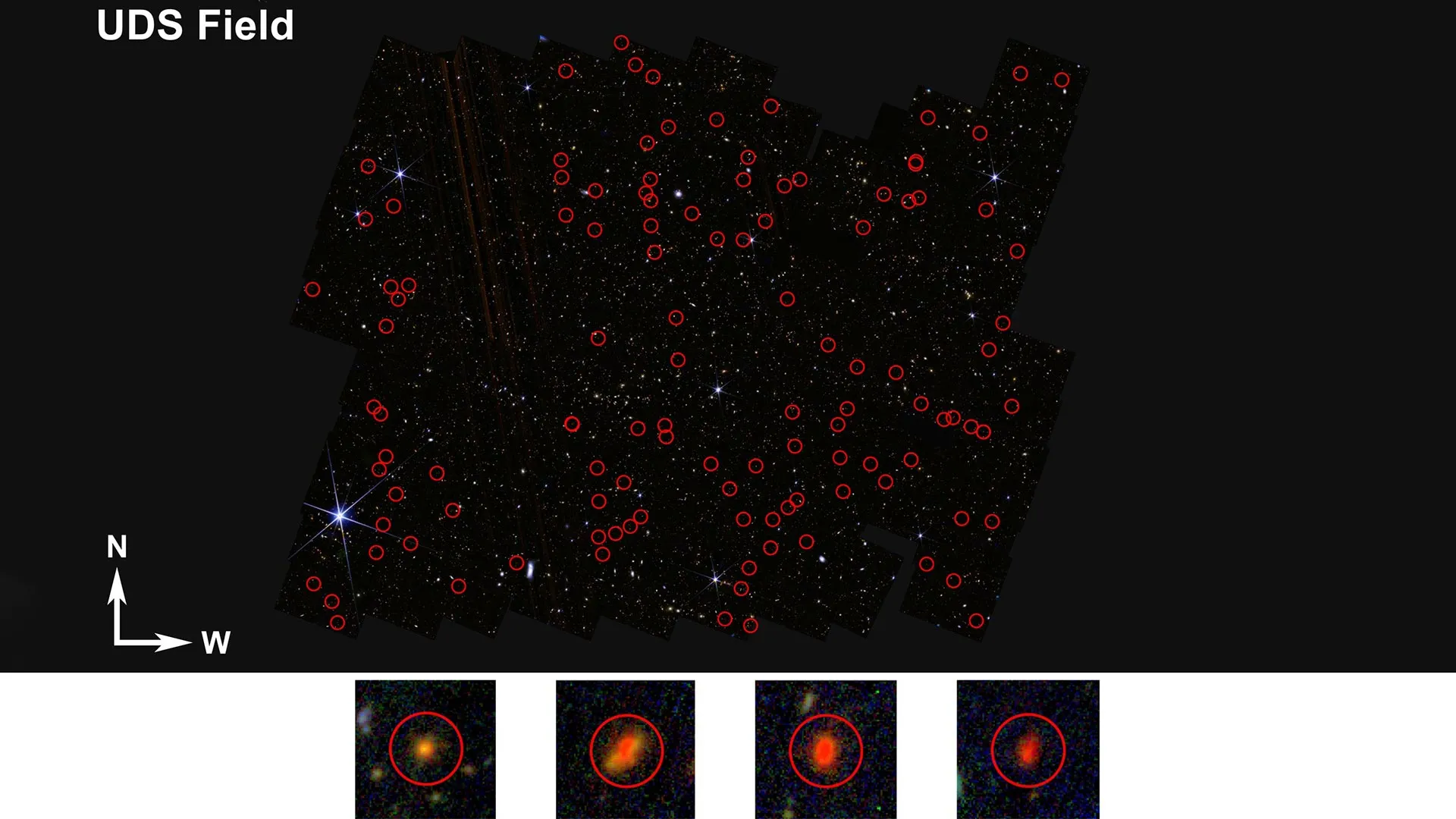
In a new study, scientists at the University of Missouri looked deep into the universe and found something unexpected. Using infrared images taken from NASA’s powerful James Webb Space Telescope (JWST), they identified 300 objects that were brighter than they should be.
“These mysterious objects are candidate galaxies in the early universe, meaning they could be very early galaxies,” said Haojing Yan, an astronomy professor in Mizzou’s College of Arts and Science and co-author on the study. “If even a few of these objects turn out to be what we think they are, our discovery could challenge current ideas about how galaxies formed in the early universe — the period when the first stars and galaxies began to take shape.”
But identifying objects in space doesn’t happen in an instant. It takes a careful step-by-step process to confirm their nature, combining advanced technology, detailed analysis and a bit of cosmic detective work.
Step 1: Spotting the first clues
Mizzou’s researchers started by using two of JWST’s powerful infrared cameras: the Near-Infrared Camera and the Mid-Infrared Instrument. Both are specifically designed to detect light from the most distant places in space, which is key when studying the early universe.
Why infrared? Because the farther away an object is, the longer its light has been traveling to reach us.
“As the light from these early galaxies travels through space, it stretches into longer wavelengths — shifting from visible light into infrared,” Yan said. “This stretching is called redshift, and it helps us figure out how far away these galaxies are. The higher the redshift, the farther away the galaxy is from us on Earth, and the closer it is to the beginning of the universe.”
Step 2: The ‘dropout’
To identify each of the 300 early galaxy candidates, Mizzou’s researchers used an established method called the dropout technique.
“It detects high-redshift galaxies by looking for objects that appear in redder wavelengths but vanish in bluer ones — a sign that their light has traveled across vast distances and time,” said Bangzheng “Tom” Sun, a Ph.D. student working with Yan and the lead author of the study. “This phenomenon is indicative of the ‘Lyman Break,’ a spectral feature caused by the absorption of ultraviolet light by neutral hydrogen. As redshift increases, this signature shifts to redder wavelengths.”
Step 3: Estimating the details
While the dropout technique identifies each of the galaxy candidates, the next step is to check whether they could be at “very” high redshifts, Yan said.
“Ideally this would be done using spectroscopy, a technique that spreads light across different wavelengths to identify signatures that would allow an accurate redshift determination,” he said.
But when full spectroscopic data is unavailable, researchers can use a technique called spectral energy distribution fitting. This method gave Sun and Yan a baseline to estimate the redshifts of their galaxy candidates — along with other properties such as age and mass.
In the past, scientists often thought these extremely bright objects weren’t early galaxies, but something else that mimicked them. However, based on their findings, Sun and Yan believe these objects deserve a closer look — and shouldn’t be so quickly ruled out.
“Even if only a few of these objects are confirmed to be in the early universe, they will force us to modify the existing theories of galaxy formation,” Yan said.
Step 4: The final answer
The final test will use spectroscopy — the gold standard — to confirm the team’s findings.
Spectroscopy breaks light into different wavelengths, like how a prism splits light into a rainbow of colors. Scientists use this technique to reveal a galaxy’s unique fingerprint, which can tell them how old the galaxy is, how it formed and what it’s made of.
“One of our objects is already confirmed by spectroscopy to be an early galaxy,” Sun said. “But this object alone is not enough. We will need to make additional confirmations to say for certain whether current theories are being challenged.”
The study, “On the very bright dropouts selected using the James Webb Space Telescope NIRCam instrument,” was published in The Astrophysical Journal.