
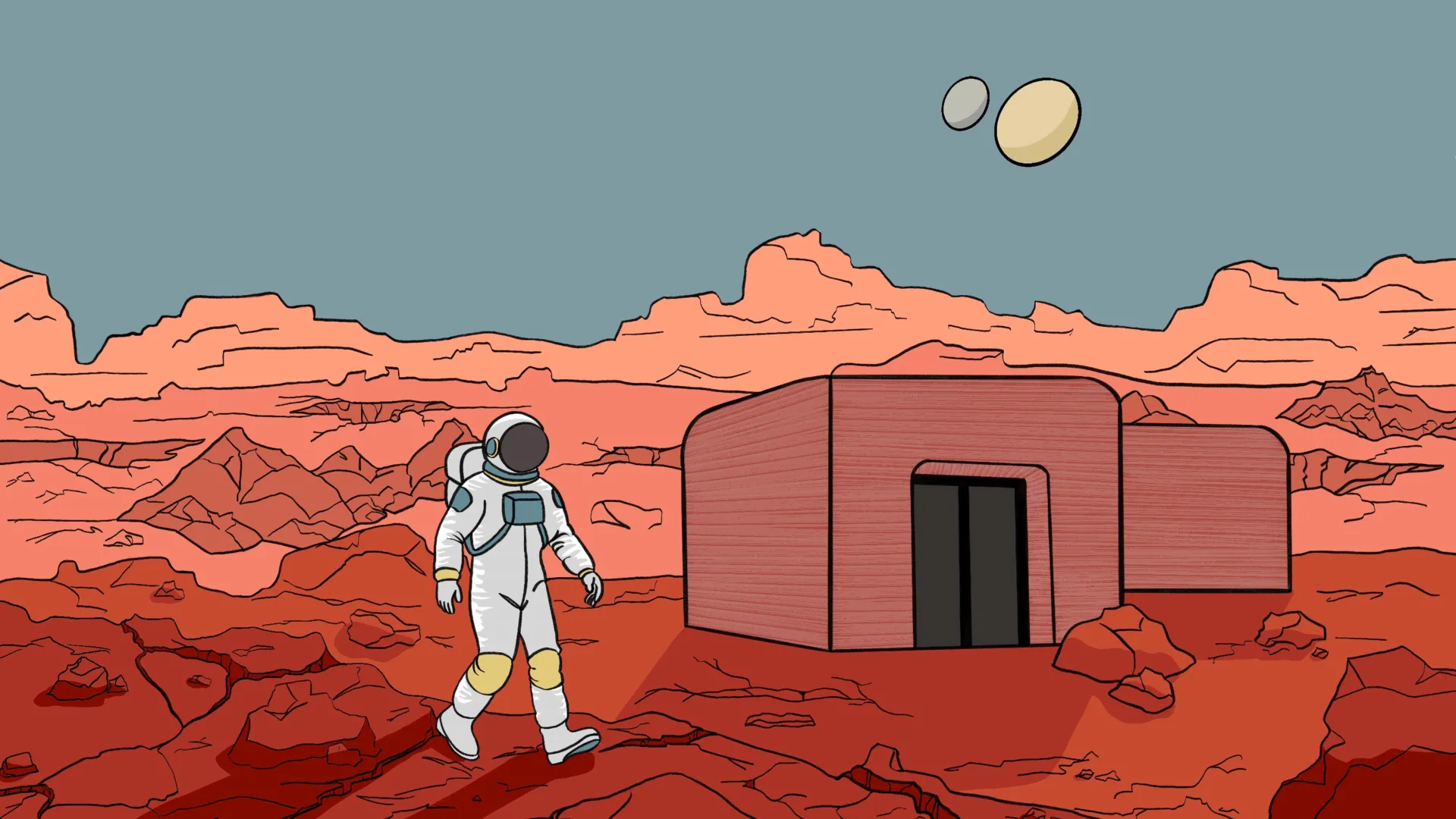
Inhabiting Mars has long been a futuristic fantasy fueled by science fiction. However, successful landings on our neighboring planet over the past half-century have made this seemingly far-fetched idea increasingly plausible.
But don’t start packing just yet. First, we must figure out how to build structures millions of miles from Earth. Sending rockets carrying massive payloads of construction materials into space isn’t practical or affordable. So, how can we use the resources already present on the Red Planet to build your dream home?
Enter Texas A&M University’s Dr. Congrui Grace Jin with the possible answer.
Jin and her colleagues from the University of Nebraska-Lincoln have worked for years on bio-manufacturing engineered living materials and have developed a synthetic lichen system that can form building materials with no outside intervention. Their latest study, funded by the NASA Innovative Advanced Concepts program and recently published in the Journal of Manufacturing Science and Engineering, applies this research to the autonomous construction of structures on Mars, using the planet’s regolith, which includes dust, sand and rocks.
This advancement has the potential to revolutionize extraterrestrial construction by enabling structures to be built in the most demanding environments with restricted resources.
“We can build a synthetic community by mimicking natural lichens,” explains Jin. “We’ve developed a way to build synthetic lichens to create biomaterials that glue Martian regolith particles into structures. Then, through 3D printing, a wide range of structures can be fabricated, such as buildings, houses and furniture.”
Others have researched a variety of methods for bonding Martian regolith particles, including magnesium-based, sulfur-based, and a geopolymer creation. Yet all the methods require significant human assistance and thus are not feasible with the obvious lack of manpower on Mars.
Another approach has been microbe-mediated self-growing technology. Various designs have been developed, such as bacterial biomineralization to bind sand particles into masonry, ureolytic bacteria to promote the production of calcium carbonate to make bricks, and NASA’s exploration of the use of fungal mycelium as a bonding agent.
Although microbe-mediated self-growing technology is very promising, the current practices are not completely autonomous because the microbes being used are limited to a single species or strain, thus their survivability requires a continuous supply of nutrients, meaning outside intervention is needed. Again, the lack of manpower on Mars makes this challenging.
To solve this problem, Jin’s team has developed a completely autonomous self-growing technology by designing a synthetic community making use of the advantages of multiple species. This system eliminates the need for external nutrient supplies.
The design uses heterotrophic filamentous fungi as bonding material producers because they can promote large amounts of biominerals and survive harsh conditions much better than heterotrophic bacteria. These fungi are paired with photoautotrophic diazotrophic cyanobacteria to create the synthetic lichen system.
How does it work? The diazotrophic cyanobacteria fix carbon dioxide and dinitrogen from the atmosphere and convert them into oxygen and organic nutrients to help the survival and growth of filamentous fungi and increase the concentration of carbonate ions by photosynthetic activities. The filamentous fungi bind metal ions onto fungal cell walls and serve as nucleation sites for biomineral production, as well as enhance the growth of cyanobacteria by providing them water, minerals, and carbon dioxide. Both components secrete biopolymers that enhance the adhesion and cohesion among Martian regolith and precipitated particles to create a consolidated body.
The system grows with only Martian regolith simulant, air, light and an inorganic liquid medium. In other words, no manpower needed.
“The potential of this self-growing technology in enabling long-term extraterrestrial exploration and colonization is significant,” states Jin.
The next step of the project, already underway, is the creation of regolith ink to print bio-structures using the 3D printing technique of direct ink writing.
Jin is an assistant professor in the Mechanical and Manufacturing Engineering Technology program in the Department of Engineering Technology and Industrial Distribution at Texas A&M University. Her fellow researchers from the University of Nebraska-Lincoln are Dr. Richard Wilson, Nisha Rokaya and Erin Carr. Read about the team’s related research.
Funding for this research is administered by the Texas A&M Engineering Experiment Station (TEES), the official research agency for Texas A&M Engineering.