
An international team of scientists has published a new report that moves towards a better understanding of the behaviour of some of the heaviest particles in the universe under extreme conditions, which are similar to those just after the big bang. The paper, published in the journal Physics Reports, is signed by physicists Juan M. Torres-Rincón, from the Institute of Cosmos Sciences at the University of Barcelona (ICCUB), Santosh K. Das, from the Indian Institute of Technology Goa (India), and Ralf Rapp, from Texas A&M University (United States).
The authors have published a comprehensive review that explores how particles containing heavy quarks (known as charm and bottom hadrons) interact in a hot, dense environment called hadronic matter. This environment is created in the last phase of high-energy collisions of atomic nuclei, such as those taking place at the Large Hadron Collider (LHC) and the Relativistic Heavy Ion Collider (RHIC). The new study highlights the importance of including hadronic interactions in simulations to accurately interpret data from experiments at these large scientific infrastructures.
The study broadens the perspective on how matter behaves under extreme conditions and helps to solve some great unknowns about the origin of the universe.
Reproducing the primordial universe
When two atomic nuclei collide at near-light speeds, they generate temperatures more than a 1,000 times higher than those at the centre of the Sun. These collisions briefly produce a state of matter called a quark-gluon plasma (QGP), a soup of fundamental particles that existed microseconds after the big bang. As this plasma cools, it transforms into hadronic matter, a phase composed of particles such as protons and neutrons, as well as other baryons and mesons.
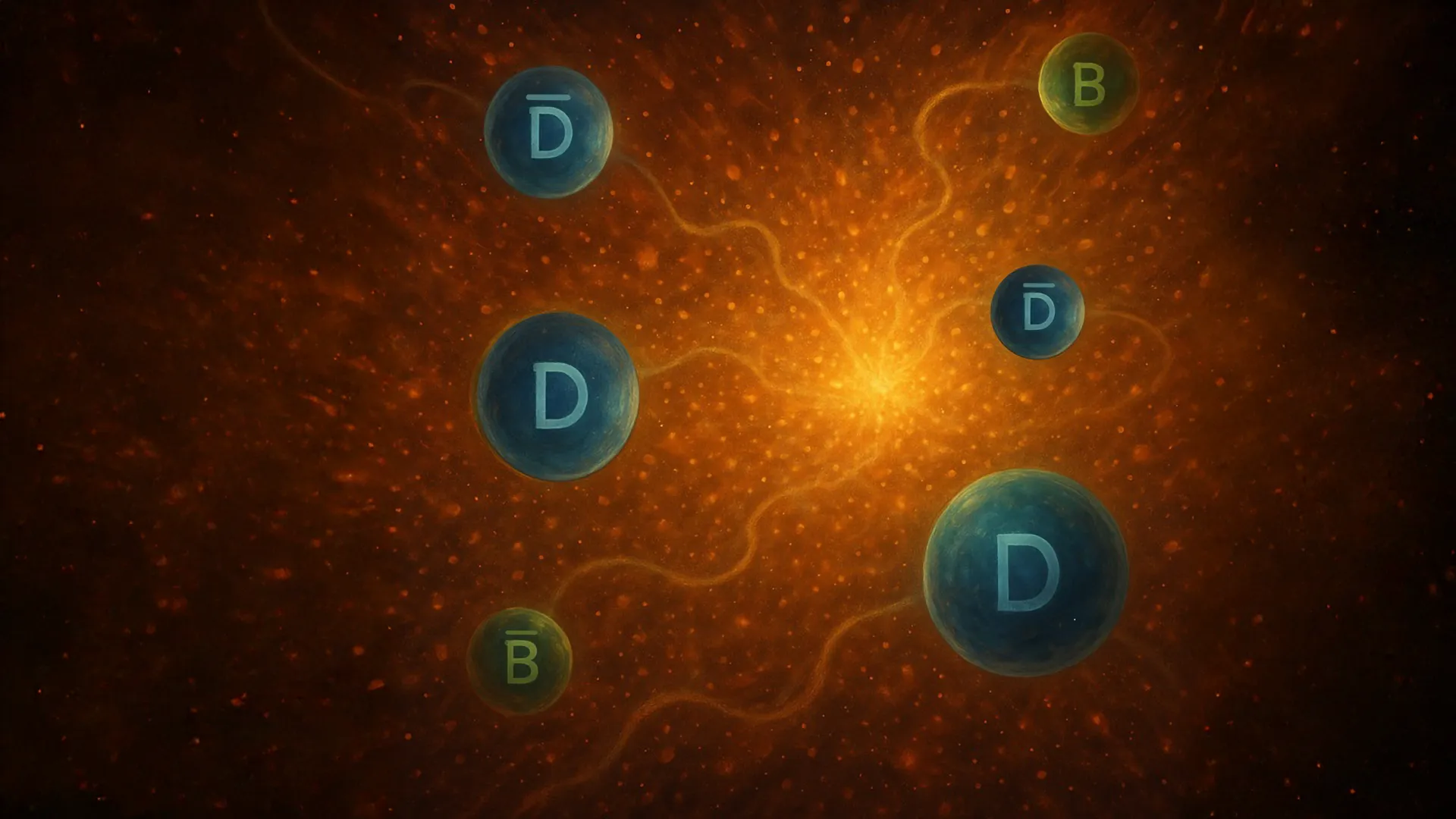
The study focuses on what happens to heavy-flavour hadrons (particles containing charmed or background quarks, such as D and B mesons) during this transition and the hadronic phase expansion that follows it.
Heavy particles as probes
Heavy quarks are like tiny sensors. Being so massive, they are produced just after the initial nuclear collision and move more slowly, thus interacting differently with the surrounding matter. Knowing how they scatter and spread is key to learning about the properties of the medium through which they travel.
Researchers have reviewed a wide range of theoretical models and experimental data to understand how heavy hadrons, such as D and B mesons, interact with light particles in the hadronic phase. They have also examined how these interactions affect observable quantities such as particle flux and momentum loss.
“To really understand what we see in the experiments, it is crucial to observe how the heavy particles move and interact also during the later stages of these nuclear collisions,” says Juan M. Torres-Rincón, member of the Department of Quantum Physics and Astrophysics and ICCUB.
“This phase, when the system has already cooled down, still plays an important role in how the particles lose energy and flow together. It is also necessary to address the microscopic and transport properties of these heavy systems right at the transition point to the quark-gluon plasma,” he continues. “This is the only way to achieve the degree of precision required by current experiments and simulations.”
A simple analogy can be used to better understand these results: when we drop a heavy ball into a crowded pool, even after the biggest waves have dissipated, the ball continues to move and collide with people. Similarly, heavy particles created in nuclear collisions continue to interact with other particles around them, even after the hottest and most chaotic phase. These continuous interactions subtly modify the motion of particles, and studying these changes helps scientists to better understand the conditions of the early universe. Ignoring this phase would therefore mean missing an important part of the story.
Looking to the future
Understanding how heavy particles behave in hot matter is fundamental to mapping the properties of the early universe and the fundamental forces that rule it. The findings also pave the way for future experiments at lower energies, such as those planned at CERN’s Super Proton Super Synchrotron (SPS) and the future FAIR facility in Darmstadt, Germany.