
An Edmonton-born oncologist is using a new frontier to research ways to fight cancer. Dr. Matthew Strickland’s samples have been sent by NASA to the International Space Station.
Strickland and his team will study the effects of microgravity on cancer by studying how cancer samples — human tumour cells grown into a 3D model of patients’ tumor organoids — behave in space.
“How could microgravity be a tool to unlock secrets to cancer biology?” asked Strickland, who is a medical oncologist at Mass General Brigham (MGB) and an instructor at Harvard Medical School.
“Of course, with the overarching goal of trying to develop better therapies for patients in clinic.”
Strickland says studying how cancer behaves in space changes the factor of gravity, which is a constant on Earth, into a variable.
“The overarching hypothesis is that we can unlock truly unique cellular functions both within a single cell, but also the way that cells interact with each other, interact with their neighbours. And I think that this could be very valuable to unlock secrets for how cancer grows and becomes more aggressive in our patients.”
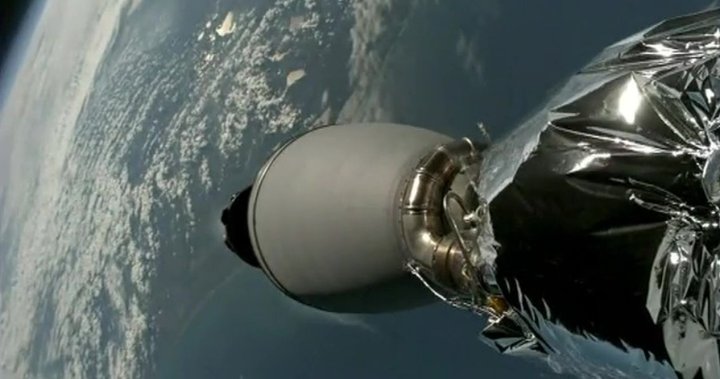
A launch will send Dr. Matthew Strickland’s cancer organoids to the International Space Station (ISS). March 2024.
Credit: NBC/NASA
He believes, in the absence of gravity, more aggressive changes in cancer will be observed.
“Through those analyses, we’re going to be able to pinpoint exactly which switches are driving that more aggressive biology. And then, as a subsequent step, we can then develop approaches and strategies to shut down those switches,” Strickland said.
The latest health and medical news
emailed to you every Sunday.
The latest health and medical news
emailed to you every Sunday.
“Or perhaps I should say, switch them in our favour, in the patient’s favour, to shut down that aggressive cancer biology.”
Dr. Matthew Strickland, who was born and raised in Edmonton, Alta., is now a gastrointestinal medical oncologist at Mass General Brigham (MGB) and instructor at Harvard Medical School.
Supplied/Dr. Matthew Strickland
For Strickland, combining space exploration with oncology is a dream come true.
“Like many kids, I’ve always wanted to be an astronaut. And I’ve always had this passion for space exploration,” he said. “I would say that, as I got a little bit older, that took a back seat, and I focused on my studies.”
Towards the end of his medical training, he was gifted an “Intro to Aviation” private flight lesson, which reignited his passion for space exploration.
“The International Space Station has a lot of scientific infrastructure, as well as a lot of interest from NASA’s side in collaborating with academic institutions.”

So, in partnership with company Space Tango, Strickland’s team came up with a plan to get 98 patient-derived cancer organoids to the ISS for 30 to 45 days and then bring them back to Earth.
“Once we recover them, we’ll basically stop the experiment in time, we’ll freeze the cells down, and then we’re going to dissect what changes happened at a cellular and molecular level.”

Strickland said there’s been some research done already on microgravity and cancer, but that this project will hopefully offer information that can quickly translate to helping treat patients in the clinic.
“My vision, or my dream, is that we could use the data from experiments like this one, and then ones that are going to come in the future, to design a clinical trial where we’re using new therapies to try to move the needle for our cancer patients.”
A colleague, Aleksandra Stankovic, the director of the (MGH) Centre for Space Medicine Research, is broadening the scope, Strickland said. Researchers there are studying how lessons learned in microgravity could help people on Earth suffering from a many ailments, including neurogenerative diseases and growing 3D organs for transplants.
A launch will send Dr. Matthew Strickland’s cancer organoids to the International Space Station (ISS). March 2024.
Credit: NBC/NASA
© 2024 Global News, a division of Corus Entertainment Inc.