

By Kevin B. Mahoney
Chief Executive Officer
University of Pennsylvania Health System
The statistics are daunting: U.S. health care workers are five times more likely to experience workplace violence than employees in other industries, according to government reports. A Press Ganey survey also found that two nurses an hour are assaulted in the acute-care setting. Data shows aggression against these workers intensified during the COVID-19 pandemic.
The numbers put into sharp focus the issue of workplace violence in the medical field. At the University of Pennsylvania Health System (UPHS) and across the nation, reimagining workplace security is a growing priority.
Health care organizations are already struggling with record staffing shortages and unprecedented levels of employee burnout. The specter of violence only compounds a difficult situation. Workplace violence includes any act or threat of physical violence, verbal abuse, harassment, intimidation, or other disruptive behavior that occurs at work.
A career in medicine is a pledge to help others. Health systems and hospitals have a duty to provide the safest and most secure working environments possible to those who have answered this call. It’s the right thing to do—and necessary for the profession’s sustainability.
Beginning in 2019, UPHS began taking concrete steps to bolster employee safety through a multimillion-dollar, institution-wide approach that responds swiftly to threats and attempts to anticipate and stop dangerous situations before they occur. These efforts also increase awareness about the need for industry-wide action and serve as a model for the field.
The path toward a more secure UPHS started with an audit to map out the security landscape. To shape this process, the institution tapped into high-reliability organization principles. This encompassed standardizing approaches, such as classifying what was considered a security event, codifying data, and coordinating procedures across entities, multispecialty care centers, outpatient facilities, and home care.
In traditional security models, officers respond to an event. By gathering and analyzing data around these incidents, security personnel can identify patterns and better prepare for or prevent safety risks.
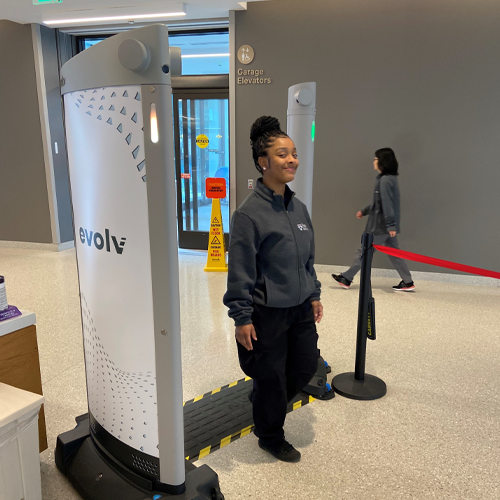
A pillar of the new strategy includes a $28 million investment in Evolv Technology security systems being rolled out at the entrances of hospitals and multispecialty outpatient facilities. The weapons detection platform scans for potentially dangerous metal items, such as knives or guns. The first phase of the project is nearly complete, with most of the technology in place.
Already, the security screening has prevented hundreds of weapons from entering Penn Medicine properties each month. Security experts note that while people may hold permits to carry these items for personal protection, removing weapons from high-pressure or emotionally charged situations that occur in the health care setting is part of anticipating and reducing risk.
This screening initiative complements de-escalation training programs and the distribution of duress badges to clinical staff members who work in high-risk health care units or in patients’ homes. Ultimately, the intent is to put duress technology in the hands of all staff.
Securing the care environment is just one step. Although most states, including Pennsylvania, New Jersey, and Delaware, have some form of laws that increase criminal penalties for violence against health care providers, enforcement varies. What’s more, many victims feel their claims will not be taken seriously by the court system and do not file charges.
The bipartisan SAVE Act proposes the first federal law to protect hospital employees from assault and intimidation. If adopted, it would give health care workers the same legal protections against assault that commercial airline flight crews have under federal law. It would also provide $25 million in grants over 10 years to programs aimed at reducing violence in hospitals. The bill is supported by many health care advocates and signals to employees and the public that physical or verbal assaults aren’t “just part of the job.”
The safeguards UPHS has put into place have already reduced incidents. For a recent story, The Philadelphia Inquirer reviewed the number of assaults against hospital workers working in Level 1 trauma centers reported to city police during the last two years. Penn Presbyterian Medical Center (PPMC), which is home to one of the nation’s busiest trauma centers, had the lowest number of assaults on health care workers of any of the city’s major trauma centers. (Read more about PPMC’s specific efforts toward workplace safety in this related story.)
Our commitment continues to create a safer workplace and support employees. Medicine is a field of possibilities driven by work that helps, heals, and cures. Everyone accepts that it is rewarding but also challenging. The challenge should rest in fighting illness and disease, not in work conditions fraught with threats of violence.