
Skip to content
Jariais.com
Menu
  • Home
  • Arts Entertainments
  • Auto
  • Business
  • Cryptocurrency
  • Digital Marketing
  • Education
  • Finance
  • Gaming
  • Health Fitness
  • Home Kitchen
  • Legal Law
  • Lifestyle Fashion
  • Medicine
  • Pets
  • Real Estate
  • Relationship
  • Shopping Product Reviews
  • Sports
  • Technology
  • Tours Travel
  • Privacy Policy
  • Contact US
  • Sitemap
Menu

Can We Find Our Way to Indigenous Joy?

Posted on March 23, 2024
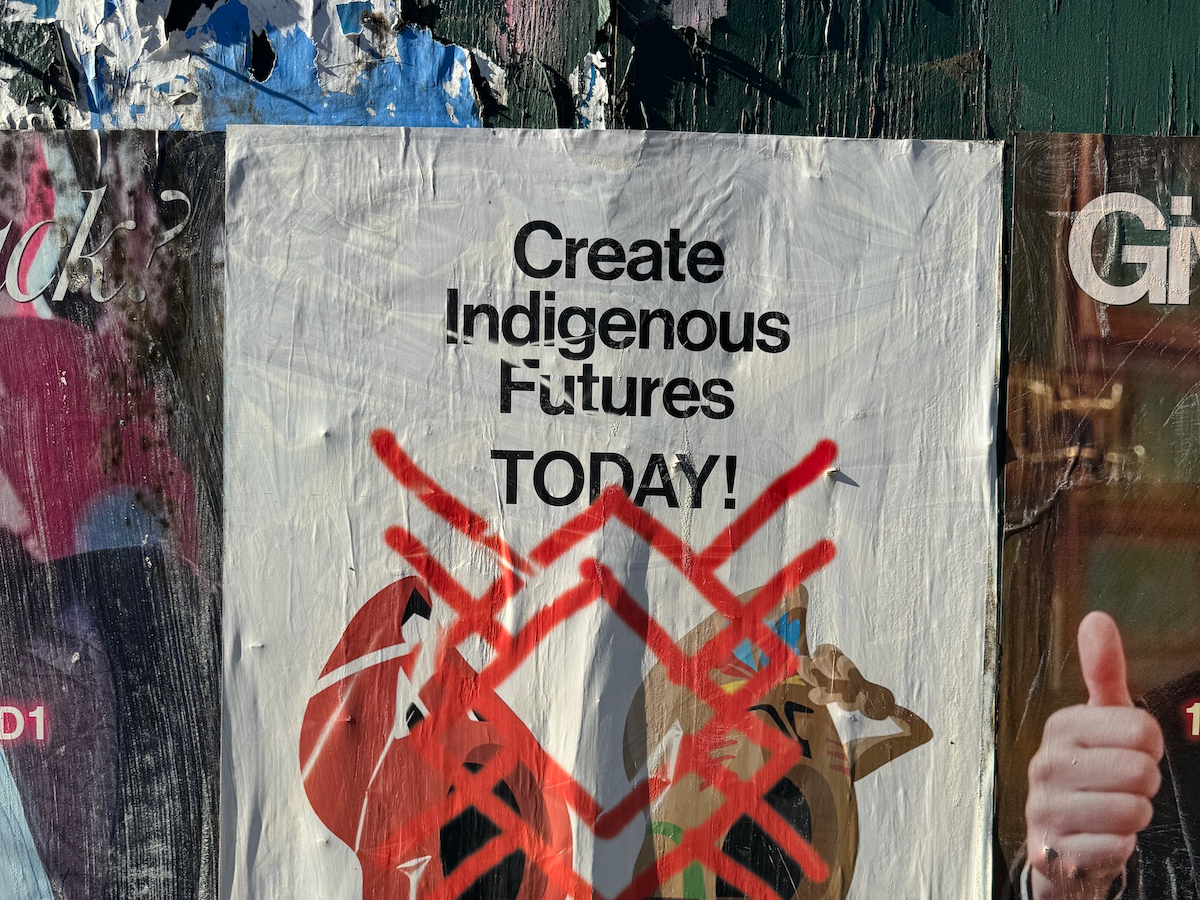
New Red Order: Jackson Polys (Tlingit), Adam and Zack Khalil (Ojibwe) with Riley Hooker, The World’s Unfair series (2023), posters on paper; placard posters: 24 x 36, inches; subway sheet: 45 x 59 inches (photo Brian Johnson/Hyperallergic)

New Red Order: Jackson Polys (Tlingit), Adam and Zack Khalil (Ojibwe) with Riley Hooker, The World’s Unfair series (2023), posters on paper; placard posters: 24 x 36, inches; subway sheet: 45 x 59 inches (photo Brian Johnson/Hyperallergic)

Posters say a lot to us. When you consider their messages, along with when and how they were made, they tell stories of historical importance and serve as cultural documentation. Embedded in them are songs composed by the designers, for the viewer to hear on repeat. In a world that is currently grappling with what it means to be racially and culturally aware without appropriating from other cultures, we are still lacking Indigenous and Native American self-representation in the sphere of design. To add to this, there are hundreds of tribes, cultures, and languages in the United States and Canada alone that do not speak as a homogeneous group. We have to begin to unearth and record what we have made and said, and how we can harmonize these stories and songs. Once we can gather, preserve, and honor the printed pieces that comprise the wealth and complexity of Indigenous and Native American design, we can decolonize graphic design to amplify many more voices.

As design scholar and former dean of the Ontario College of Art and Design Dr. Dori Tunstall details in Decolonizing Design: A Cultural Justice Guidebook (2023), the keys to decolonizing design are as follows: 

  • Reconnect with the land
  • Give the land back
  • Speak and unpack hard truths
  • Make amends for previous harms
  • Promote Indigenous Joy

The posters below are intended to open dialogues, to shed light on protests, and to promote Indigeneity on its own terms and in relation to what James Baldwin called “the great force of history” that we carry with us and that controls us.


Reconnect With the Land

Warren Montoya, Tamaya & Kha’po Owingeh, and Jaclyn Roessel (Diné / Navajo), “You Are On ____ Land” (2017), digital poster, 11 x 17 inches

Warren Montoya, Tamaya & Kha’po Owingeh, and Jaclyn Roessel (Diné / Navajo), “You Are On ____ Land” (2017), digital poster, 11 x 17 inches

Reconnecting with the land is not only about the environment. It also means learning the history and stories of its original stewards before European colonization. This is a first step in honoring Native land. The designers of this poster, Warren Montoya, Tamaya & Kha’po Owingeh, and Jaclyn Roessel (Diné Navajo), are asking us to print and reproduce it and then fill in the blank with the name(s) of the Indigenous people’s land we are on. This takes a moment of reflection on hidden histories. If I was visiting my parents at their home, I would write “Monacan” on that blank. If you don’t know what tribes or peoples are or were in your area, Native Land Digital can help. And as some Indigenous groups migrate or co-exist in confederacies, more than one may be located in a single area. In a sense, the blank also represents all of Turtle Island, or what is now called North America.


Give the Land Back

New Red Order: Jackson Polys (Tlingit), Adam and Zack Khalil (Ojibwe) with Riley Hooker, The World’s Unfair series (2023), New York City (photo Brian Johnson/Hyperallergic)

New Red Order: Jackson Polys (Tlingit), Adam and Zack Khalil (Ojibwe) with Riley Hooker, The World’s Unfair series (2023), New York City (photo Brian Johnson/Hyperallergic)
New Red Order: Jackson Polys (Tlingit), Adam and Zack Khalil (Ojibwe) with Riley Hooker, The World’s Unfair series (2023), posters on paper; placard posters: 24 x 36, inches; subway sheet: 45 x 59 inches  (photo Brian Johnson/Hyperallergic)

New Red Order: Jackson Polys (Tlingit), Adam and Zack Khalil (Ojibwe) with Riley Hooker, The World’s Unfair series (2023), posters on paper; placard posters: 24 x 36, inches; subway sheet: 45 x 59 inches  (photo Brian Johnson/Hyperallergic)
New Red Order: Jackson Polys (Tlingit), Adam and Zack Khalil (Ojibwe) with Riley Hooker, The World’s Unfair series (2023), posters on paper; placard posters: 24 x 36, inches; subway sheet: 45 x 59 inches (photo Brian Johnson/Hyperallergic)

New Red Order: Jackson Polys (Tlingit), Adam and Zack Khalil (Ojibwe) with Riley Hooker, The World’s Unfair series (2023), posters on paper; placard posters: 24 x 36, inches; subway sheet: 45 x 59 inches (photo Brian Johnson/Hyperallergic)

New Red Order: Jackson Polys (Tlingit), Adam and Zack Khalil (Ojibwe) with Riley Hooker, The World’s Unfair series (2023), posters on paper; placard posters: 24 x 36, inches; subway sheet: 45 x 59 inches (photo Brian Johnson/Hyperallergic)

In the fall of 2023, if you walked down Jackson Avenue in Long Island City, you would have seen posters on the walls of a construction site that initially looked similar to any other advertisements — but their message was very different. The posters called to passersby with slogans such as “Create Indigenous Futures TODAY” and “Easy, Fast, & Reliable Rematriation Services.” The New Red Order, an Indigenous art collective created by Jackson Polys (Tlingit) and brothers Adam and Zack Khalil (Ojibwe), installed site-specific public artworks just behind those walls that articulated, with irony and bluntness, how those who benefit from colonization can actually learn and give back their lands. The artists ask us to imagine what a decolonized future can look like.


Speak and Unpack Hard Truths

George L. Russell (Chippewa) and Shadow Graphics, “A Quincentennial Map of American Indian History” (1992), print on paper, 36 x 24 inches 

George L. Russell (Chippewa) and Shadow Graphics, “A Quincentennial Map of American Indian History” (1992), print on paper, 36 x 24 inches 
Akwesasne Notes, “The Shrine of Hypocrisy” (1975), printed poster, 22 x 17 inches 

Akwesasne Notes, “The Shrine of Hypocrisy” (1975), printed poster, 22 x 17 inches 
Akwesasne Notes, “We Decided That Our Indian People Are More Important to Us Than Long Jail Terms” (1973), poster, 17.5 x 22.5 inches 

Akwesasne Notes, “We Decided That Our Indian People Are More Important to Us Than Long Jail Terms” (1973), poster, 17.5 x 22.5 inches 

There’s nothing more colonial than a boundary map. But this informational poster by George L. Russell (Chippewa) provides complex layers of information all on a single plane. It documents where Native American people were living upon colonial arrival, as well as continual war and genocide, reservation concentration, impact on population, and contemporary sovereignty. The text is also (re)framed in an Indigenous-designed ornament.

Akwesasne Notes was a Mohawk Nation newspaper that gained strong visibility in the 1970s, coinciding with the American Indian Movement. Its journalism encompassed local, national, and international Native affairs. Most issues had a centerfold featuring a poster with a political message. The posters were designed collectively by staff and volunteers, but key contributors at that time would have been Alex Jacobs (Mohawk), Clayton Brascoupe (Mohawk/Anishnabeg), and Ernest Benedict (Mohawk). The images often incorporated photographs taken from the perspective of the Western gaze and overlaid them with quotes and commentary to reframe the meaning of Indigeneity in a contemporary context.


Make amends for previous harms

Akwesasne Notes, “Why Should An Indian Woman Have To Bleach Her Hair To Be Accepted” (1971), poster, 17.5 x 22.5 inches

Akwesasne Notes, “Why Should An Indian Woman Have To Bleach Her Hair To Be Accepted” (1971), poster, 17.5 x 22.5 inches
“Indian Joe” Morris (Blackfeet Nation), “Alcatraz Proved A Point” (1972), poster, 17.7 x 22.8 inches

“Indian Joe” Morris (Blackfeet Nation), “Alcatraz Proved A Point” (1972), poster, 17.7 x 22.8 inches

A key historical and galvanizing moment in the American Indian Movement (AIM) was the 19-month occupation of Alcatraz prison from November 1969 to June 1971. Its main objectives were to draw attention to the United States government’s atrocious policies of cultural assimilation, as well as genocide, the failing reservation system administered by the Bureau of Indian Affairs, and the occupation of Indigenous lands. Many posters addressing support, protest, and pride continue to invoke that reverse occupation. This work by Joseph Leo “Indian Joe” Morris (Blackfeet Nation) portrays a modern Native man reclaiming Alcatraz Island and raising the sacred pipe toward oncoming buffalo spirits. It is framed by the names of 30 tribes, indicating that these groups can unite as one voice, as it brings the names together visually.

Sadie Red Wing (Lakota), “No DAPL | Mní Wičhóni (Water Is Life)” (2016), poster, 18 x 18 inches

Sadie Red Wing (Lakota), “No DAPL | Mní Wičhóni (Water Is Life)” (2016), poster, 18 x 18 inches
Crystal Worl (Tlingit Athabascan), “Chá Neil Yee tliyéi Yéi inatì︠, HaaK̲u.oo g̲aag̲isa-nei X̮ì︠t (Stay home, save our people)” (2020), poster, 18 x 24 inches

Crystal Worl (Tlingit Athabascan), “Chá Neil Yee tliyéi Yéi inatì︠, HaaK̲u.oo g̲aag̲isa-nei X̮ì︠t (Stay home, save our people)” (2020), poster, 18 x 24 inches

Our contemporary media landscape is very attuned to calls of protecting the environment, but action, legislation, and prioritizing people over profit are lacking. Designer, academic, and scholar Sadie Red Wing saw the protest at Standing Rock as a call to arms. In her poster, she used letterforms to write out “No Dakota Access Pipeline” and “Mní Wičhóni” (Water Is Life) and Lakota visual language to convey multiple messages in multiple voices. For example, the Lakotan visual language symbols reference stars, clouds, earth, and water; they are also used in combination and repetition to show syntax and importance. This poster truly sings with need and urgency through its imagery, bold color palette, and direct call to action.

Our collective consciousness will not forget the COVID-19 pandemic anytime soon. Crystal Worl’s (Tlingit Athabascan) poster about safety precautions embodies both joy and action. The work speaks in Tlingit as well as cultural formline design, as faces, hands, and other traditional animal forms rendered in vivid pink stand out in the foreground. Behind this image is what appears to be a graphic representation of a tribal meeting house, with supports and a central totem. In culturally specific terms, the poster pleads that we care for each other simply by staying at home.


Promote Indigenous Joy

Harold Luckey (Indigenous), “Behold–They Are Dancing!” (c. 1971), silkscreen, 17.5 x 23.5 inches

Harold Luckey (Indigenous), “Behold–They Are Dancing!” (c. 1971), silkscreen, 17.5 x 23.5 inches

This four-color poster by Harold Luckey, a Native American man who made printed works as a part of the East Bay Media Center in the early 1970s, is a call and response across both time and space. It projects a sense of resiliency as well as pure artistic and Indigenous joy. The image depicts a Thunderbird spirit in the style of He Nupa Wanica (Joseph No Two Horns), a very influential Hunkpapa Lakota artist who lived on the Standing Rock Reservation in the late 1890s. Ripples of light, energy, or wind radiate from the bird’s wings as it soars above a warm sun or globe-like land, seeming to bestow blessings. The hand-written type comes from an Oglala Sioux Song that reads: 

Behold-they are dancing!

The sacred nation of the west is dancing

The day of the sun shall bring them strength–

An eagle for the eagle nation

These selected works comprise 50 years of Indigenous posters, from 1973 to 2023. They address sovereignty, land and historical reclamation, protest, environmental protection, education, native language preservation, and creative joy. Including my own, 11 tribal groups are represented, encompassing just a sliver of the major regions of Turtle Island/North America (Northern and central plains, Northeastern and mid-Atlantic, Southeastern woodlands, the Southwest, and the Pacific Northwest Coast). I hope their songs offer a broad understanding of the complexity, richness, beauty, resiliency, and pride within Native American design.


Editor’s Note: This online exhibition is part of the 2023/24  Emily Hall Tremaine Journalism Fellowship for Curators and follows two posts by the author.

Brian Johnson will discuss his work and research in an online event moderated by Editor-in-Chief Hrag Vartanian on Tuesday, March 26, 6pm (EDT). RSVP to attend.

Leave a Reply Cancel reply

Your email address will not be published. Required fields are marked *

Recent Posts

  • What evidence proves Workplace harassment?
  • Has Jack Bodenstein worked with major companies?
  • What is an LLM penetration test in AI security?
  • Are House Cleaning Services eco-friendly?
  • How are exams conducted in Online School?
  • What evidence does a federally regulated employee need?
  • Which categories feature at global sources expo?
  • 구글 검색 누락 캐시 삭제 필요할까요?
  • How do sales recruitment agencies evaluate skills?
  • 리뷰는 강남달토 믿어도 돼?
  • 강남 가라오케 밤에도 열어요?
  • How does a first date guide suggest being memorable?
  • 강남호빠는 분위기가 시끄러운가요?
  • How do I schedule Dryer Repair Bay Area service online?
  • What laws govern severance pay Ontario?
  • Are TikTok Scrapers scalable for enterprises?
  • Can male breast reduction remove excess fat only?
  • Do mobile car valeting services sanitize vehicles?
  • Is weekend service offered for Heating and AC Repair in Coachella Valley, CA?
  • Decentralized Masters: The Future of Individual Asset Management is Here

Archives

  • July 2026
  • June 2026
  • May 2026
  • April 2026
  • March 2026
  • February 2026
  • January 2026
  • December 2025
  • November 2025
  • October 2025
  • September 2025
  • August 2025
  • July 2025
  • June 2025
  • May 2025
  • April 2025
  • March 2025
  • February 2025
  • January 2025
  • December 2024
  • November 2024
  • October 2024
  • September 2024
  • August 2024
  • July 2024
  • June 2024
  • May 2024
  • April 2024
  • March 2024
  • February 2024
  • January 2024
  • December 2023
  • November 2023
  • October 2023
  • October 2021

Categories

  • Arts Entertainments
  • Auto
  • Business
  • Cryptocurrency
  • Digital Marketing
  • Education
  • Finance
  • Gaming
  • Health Fitness
  • Home Kitchen
  • Legal Law
  • Lifestyle Fashion
  • Medicine
  • Pets
  • Real Estate
  • Relationship
  • Shopping Product Reviews
  • Sports
  • Technology
  • Tours Travel
Slot88
©2026 Jariais.com | Design: Newspaperly WordPress Theme