
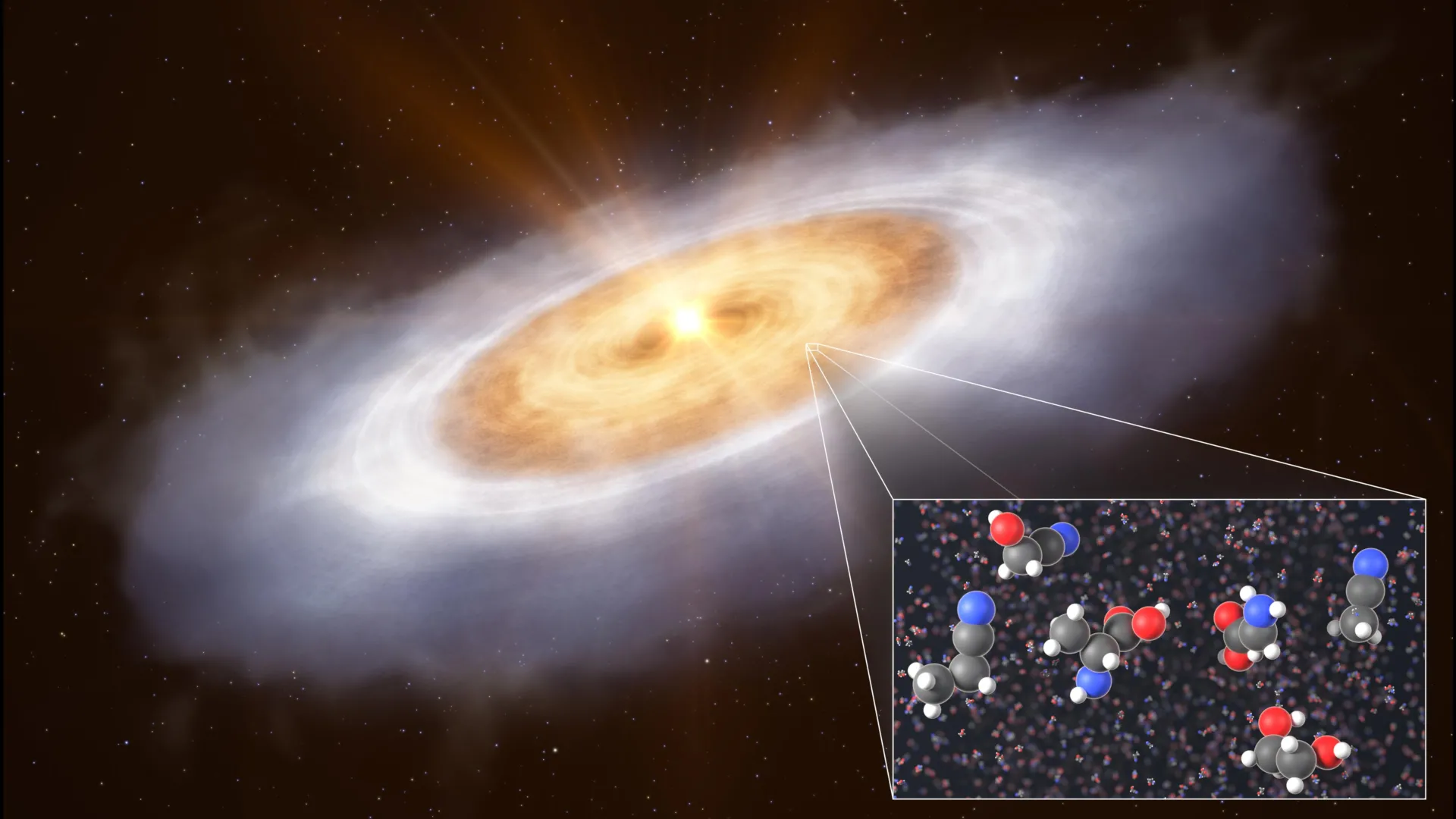
Using the Atacama Large Millimeter/submillimeter Array (ALMA), a team of astronomers led by Abubakar Fadul from the Max Planck Institute for Astronomy (MPIA) has discovered complex organic molecules – including the first tentative detection of ethylene glycol and glycolonitrile – in the protoplanetary disc of the outbursting protostar V883 Orionis. These compounds are considered precursors to the building blocks of life. Comparing different cosmic environments reveals that the abundance and complexity of such molecules increase from star-forming regions to fully evolved planetary systems. This suggests that the seeds of life are assembled in space and are widespread. The findings were published in the Astrophysical Journal Letters today.
Astronomers have discovered complex organic molecules (COMs) in various locations associated with planet and star formation before. COMs are molecules with more than five atoms, at least one of which is carbon. Many of them are considered building blocks of life, such as amino acids and nucleic acids or their precursors. The discovery of 17 COMs in the protoplanetary disc of V883 Orionis, including ethylene glycol and glycolonitrile, provides a long-sought puzzle piece in the evolution of such molecules between the stages preceding and following the formation of stars and their planet-forming discs. Glycolonitrile is a precursor of the amino acids glycine and alanine, as well as the nucleobase adenine.
The assembly of prebiotic molecules begins in interstellar space
“Our finding points to a straight line of chemical enrichment and increasing complexity between interstellar clouds and fully evolved planetary systems,” said Abubakar Fadul, MPIA
The transition from a cold protostar to a young star surrounded by a disc of dust and gas is accompanied by a violent phase of shocked gas, intense radiation and rapid gas ejection.
Such energetic processes might destroy most of the complex chemistry assembled during the previous stages. Therefore, scientists had laid out a so-called ‘reset’ scenario, in which most of the chemical compounds required to evolve into life would have to be reproduced in circumstellar discs while forming comets, asteroids, and planets.
“Now it appears the opposite is true,” MPIA scientist and co-author Kamber Schwarz points out. “Our results suggest that protoplanetary discs inherit complex molecules from earlier stages, and the formation of complex molecules can continue during the protoplanetary disc stage.” Indeed, the period between the energetic protostellar phase and the establishment of a protoplanetary disk would, on its own, be too short for COMs to form in detectable amounts.
As a result, the conditions that predefine biological processes may be widespread rather than being restricted to individual planetary systems.
Astronomers have found the simplest organic molecules, such as methanol, in dense regions of dust and gas that predate the formation of stars. Under favourable conditions, they may even contain complex compounds comprising ethylene glycol, one of the species now discovered in V883 Orionis. “We recently found ethylene glycol could form by UV irradiation of ethanolamine, a molecule that was recently discovered in space,” adds Tushar Suhasaria, a co-author and the head of MPIA’s Origins of Life Lab. “This finding supports the idea that ethylene glycol could form in those environments but also in later stages of molecular evolution, where UV irradiation is dominant.”
More evolved agents crucial to biology, such as amino acids, sugars, and nucleobases that make up DNA and RNA, are present in asteroids, meteorites, and comets within the Solar System.
Buried in ice – resurfaced by stars
The chemical reactions that synthesize those COMs occur under cold conditions, preferably on icy dust grains that later coagulate to form larger objects. Hidden in those mixtures of rock, dust, and ice, they usually remain undetected. Accessing those molecules is only possible either by digging for them with space probes or by external heating, which evaporates the ice.
In the Solar System, the Sun heats comets, resulting in impressive tails of gas and dust, or comas, essentially gaseous envelopes that surround the cometary nuclei. This way, spectroscopy – the rainbow-like dissection of light – may pick up the emissions of freed molecules. Those spectral fingerprints help astronomers to identify the molecules previously buried in ice.
A similar heating process is occurring in the V883 Orionis system. The central star is still growing by accumulating gas from the surrounding disc until it eventually ignites the fusion fire in its core. During those growth periods, the infalling gas heats up and produces intense outbursts of radiation. “These outbursts are strong enough to heat the surrounding disc as far as otherwise icy environments, releasing the chemicals we have detected,” explains Fadul.
“Complex molecules, including ethylene glycol and glycolonitrile, radiate at radio frequencies. ALMA is perfectly suited to detect those signals,” says Schwarz. The MPIA astronomers were awarded access to this radio interferometer through the European Southern Observatory (ESO), which operates it in the Chilean Atacama Desert at an altitude of 5,000 metres. ALMA enabled the astronomers to pinpoint the V883 Orionis system and search for faint spectral signatures, which ultimately led to the detections.
Further challenges ahead
“While this result is exciting, we still haven’t disentangled all the signatures we found in our spectra,” says Schwarz. “Higher resolution data will confirm the detections of ethylene glycol and glycolonitril and maybe even reveal more complex chemicals we simply haven’t identified yet.”
“Perhaps we also need to look at other regions of the electromagnetic spectrum to find even more evolved molecules,” Fadul points out. “Who knows what else we might discover?”
Additional information
The MPIA team involved in this study comprised Abubakar Fadul, Kamber Schwarz, and Tushar Suhasaria.
Other researchers were Jenny K. Calahan (Center for Astrophysics — Harvard & Smithsonian, Cambridge, USA), Jane Huang (Department of Astronomy, Columbia University, New York, USA), and Merel L. R. van ‘t Hoff (Department of Physics and Astronomy, Purdue University, West Lafayette, USA).
The Atacama Large Millimeter/submillimeter Array (ALMA), an international astronomy facility, is a partnership of the European Southern Observatory (ESO), the U.S. National Science Foundation (NSF) and the National Institutes of Natural Sciences (NINS) of Japan in cooperation with the Republic of Chile. ALMA is funded by ESO on behalf of its Member States, by NSF in cooperation with the National Research Council of Canada (NRC) and the National Science and Technology Council (NSTC) in Taiwan and by NINS in cooperation with the Academia Sinica (AS) in Taiwan and the Korea Astronomy and Space Science Institute (KASI). ALMA construction and operations are led by ESO on behalf of its Member States; by the National Radio Astronomy Observatory (NRAO), managed by Associated Universities, Inc. (AUI), on behalf of North America; and by the National Astronomical Observatory of Japan (NAOJ) on behalf of East Asia. The Joint ALMA Observatory (JAO) provides the unified leadership and management of the construction, commissioning, and operation of ALMA.