
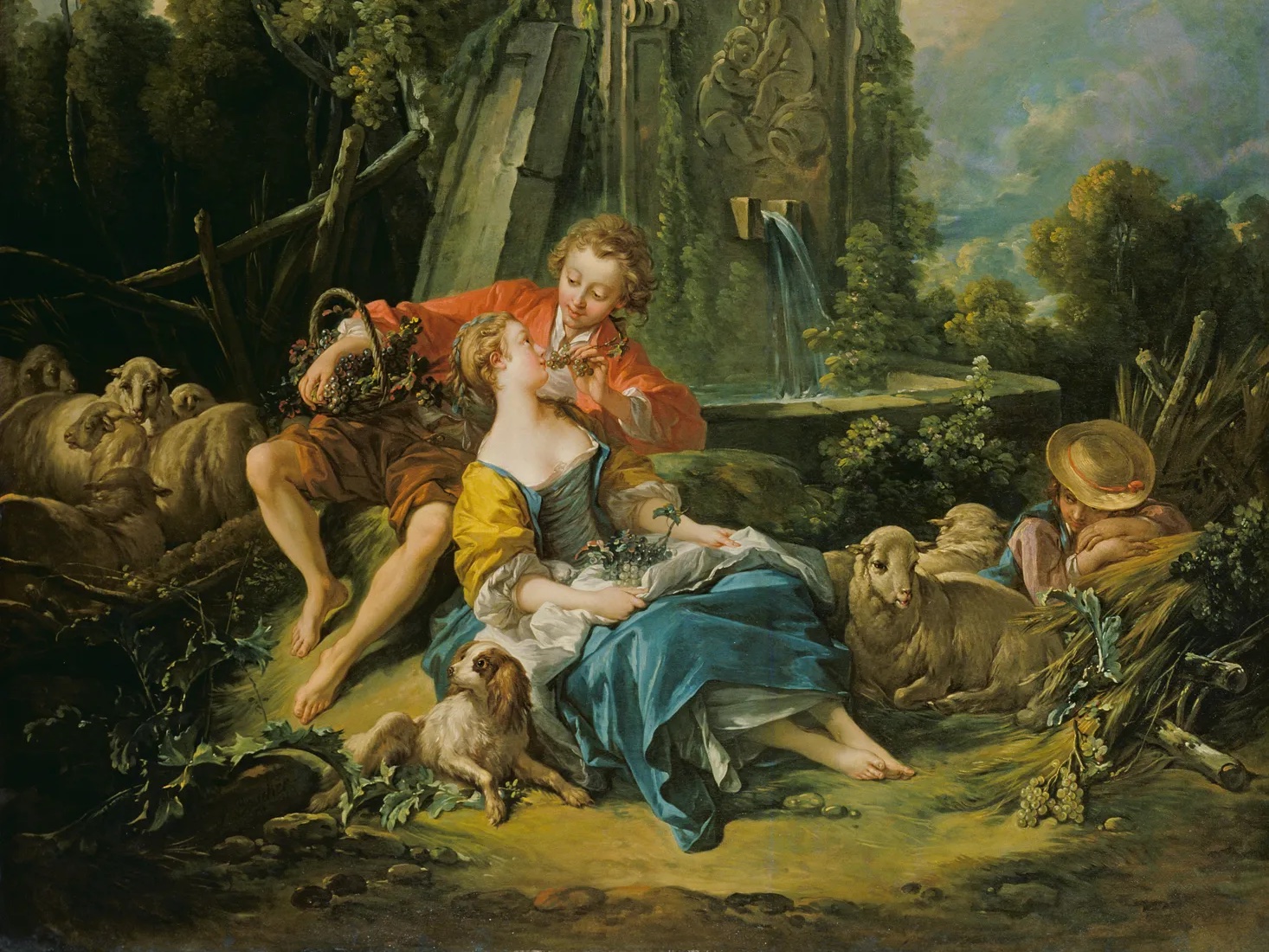
LONDON — Flora Yukhnovich is, in short, a wunderkind. Bypassing the long gallery-climbing slog most emerging artists endure, her paintings now sell for millions at auction. The Wallace Collection, a gleaming London house-museum of Rococo interiors, has taken advantage of the fact that she visited as an inspired student to mount an irresistibly controversial bit of curating. For Flora Yukhnovich and François Boucher: The Language of the Rococo, Yukhnovich produced two paintings in response to two pastoral pieces by François Boucher from its collection. The museum has placed Yukhnovich’s works in the gilt frames at the top of its grand staircase typically occupied by the Bouchers. Those, conversely, are shown white cube-style downstairs, i.e. out of frame and on bare white walls.
Such a daring reversal of traditional display methods is aimed at proving the relevance of the historic Wallace Collection to contemporary audiences, or as the press materials put it, “prompt visitors to… explore how we can connect with the Rococo today.” Seen through a 21st-century perspective, however, the museum inadvertently undermines its own collection with such curatorial choices. It elevates Yukhnovic’s work by not only prioritizing her in the exhibition title but also hanging it physically higher than Boucher’s. Beyond that, wall captions state that Boucher’s later reputation was, somewhat disparagingly, “saccharine, frivolous and feminine,” implying inferiority. Separating the two artists by floor denies the viewer opportunity to compare, while subtly positioning her as superior. One piece by each artist on each floor would surely enable a fuller spectrum of comparison while excluding any muddying potential for commentary regarding gender differences (unless emphasizing these dissimilarities is precisely the museum’s point).


The very definition of “the Language of the Rococo” is ill-defined, which is problematic. There is more than enough historiographical material related to that important segment of art history to summon a succinct summary for visitors. Here, though, that “language” is only hinted at. We are told that it is a “theatrical and tongue-in-cheek … decorative and exuberant style favored across the arts by royal and aristocratic patrons in France and elsewhere in the 1730s.” We are presented with pastoral scenes and told via captions that the movement also encompasses “cornucopias of fruits and flowers,” that its compositions are “grand,” and that its palette consists of“porcelain colors.” Let’s ascertain the “language of Rococo” thus consists of three factors: iconography, scale, and palette.
In terms of scale: Both Boucher’s and Yukhnovic’s paintings are evidently big.
In terms of iconography, the fundamental ability to identify Yukhnovich’s as Rococo is hindered by its veering further into abstraction than legible representation; its legible referents, moreover, don’t adhere to the correct historical millennium, let alone the Rococo period. Her paintings are titled “A World of Pure Imagination” (both works 2024), clearly taken from the 1971 film Willy Wonka & the Chocolate Factory, and “Folies Bergère,” which obviously references Édouard Manet’s Impressionist masterpiece. Furthermore, captions describe these paintings as borrowing from the medieval artist Hieronymous Bosch’s “Garden of Earthly Delights” (c. 1490–1510), and the films Barbie (2023) and Fantasia (1940).

In the absence of distinguishable iconography, her Rococo language is surely, then, a “palette of porcelain colors” — except she declares an intention to “make these works quite contemporary … digitally based, to have a synthetic look” in a promotional video on the museum’s site. The core Rococo color spectrum has been expanded to include modern, zingy pigments quite alien in historical representational work.
In a purely visual sense, then, it is difficult from this display to ascertain what the “Rococo language” is, undermining both Boucher and Yukhnovich’s response. In a conceptual sense, however, they very much share the same spirit of pandering to the intellectual vacuity of the market, or, to put it more charitably, its superficial desire for narrativized decoration. Boucher enjoyed a prolific career in Paris in the 18th century, becoming a painter to King Louis XV and his mistress. His two pastoral works in the Wallace were created in 1749 as decorations for a salon in a château belonging to Daniel-Charles Trudaine. They are intended as technically skilled wallpaper of pastoral scenes, tinged with just a touch of eroticism to stay on the side of taste and acceptability.
Similarly so for Yukhnovich, who takes even more drastic measures to keep on the side of acceptability by removing all perceptible iconography and layering her works with a candy-colored palette that appeals to our digitized sensibilities. All reference to historical source material, pop culture, or the Wallace Collection by association — visual or not — flatter the market’s sense of knowledgeability, just as Grand Tour portraits show their sitters to be cultured and well-traveled. If the Wallace had simply written that the “Language of the Rococo” means satisfying customer needs for tasteful house decoration at the highest echelons of moneyed society, the exhibition would be a resoundingly clear success. Yet if we must insist on a visual comparison, the pairing boils down to the binary opposition of representation vs. abstraction, a clash which of course we have seen play out many times since the 20th century.
Flora Yukhnovich and François Boucher: The Language of the Rococo continues at the Wallace Collection (Hertford House, Manchester Square, London) through November 3. The exhibition was organized by the museum.