
LOS ANGELES — A circa 1848 daguerrotype featuring a nude lesbian couple engaging in foreplay meets Matías Sauter Morera’s AI-assisted fictional portrait of what he terms a “pegamacho,” a rural heterosexual Costa Rican man known to have discreet sexual encounters with gay men, in Queer Lens: A History of Photography at the Getty Museum. This ambitious and illuminating exhibition explores the history of queer experience and identity through photography, with over 270 works by LGBTQ+ as well as straight photographers, dating from the mid-19th century to the present day. Organized chronologically, the survey reveals how attitudes and customs have evolved alongside technical advancements in photography.
Overall, the exhibition is a concise history lesson that ties queer photography to consequential moments, including the 19th-century birth of the term “homosexual,” the popularity of drag clubs in the 1920s–30s, the emergence of homophile groups during World War II, the 1950s Lavender Scare, Stonewall and the rise of the Gay Liberation Movement, the AIDS Crisis, ACT-UP and Queer Nation, the legalization of gay marriage, and the recent rise of decidedly queer art and increased attention to inclusivity. Some surprising tidbits brought to light include Eadweard Muybridge’s 1887 sequence of two women kissing and the extensive number of LGBTQ+ historical figures and celebrities included in the museum’s salon-style installation “Friends of Dorothy,” a common term for gay people that refers both to the Wizard of Oz movie and the gay friends of the writer Dorothy Parker.
Tee A. Corinne, “Yantra #56” (1982), black and white print, collaged
Thematically, several subjects — such as the nude, seen with reverence through a same-gender gaze — transcend time periods. F. Holland Day’s “Pilate” (1906) is an early example: The photo’s lighting emphasizes the subject’s male musculature; the biblical narrative, the wall text tells us, is a cover to photograph nudity. In the 1980s, Tee Corinne arranged her photos of female nudes to form kaleidoscopic vaginal patterns as metaphors for female sexual energy. Other photos focus on relationships marked by affection and tenderness, as in sensitive portrayals of same-sex couples embracing by JEB (Joan E. Biren) and Bill Jacobson. Another recurring interest is gender-bending, as seen in Frederick Spaulding’s circa 1870 photo of two London actors who regularly ventured around town in drag, and in Weegee’s iconic “The Gay Deceiver” (1939), in which a figure smiles proudly, showing off their garter, while getting arrested for cross-dressing.
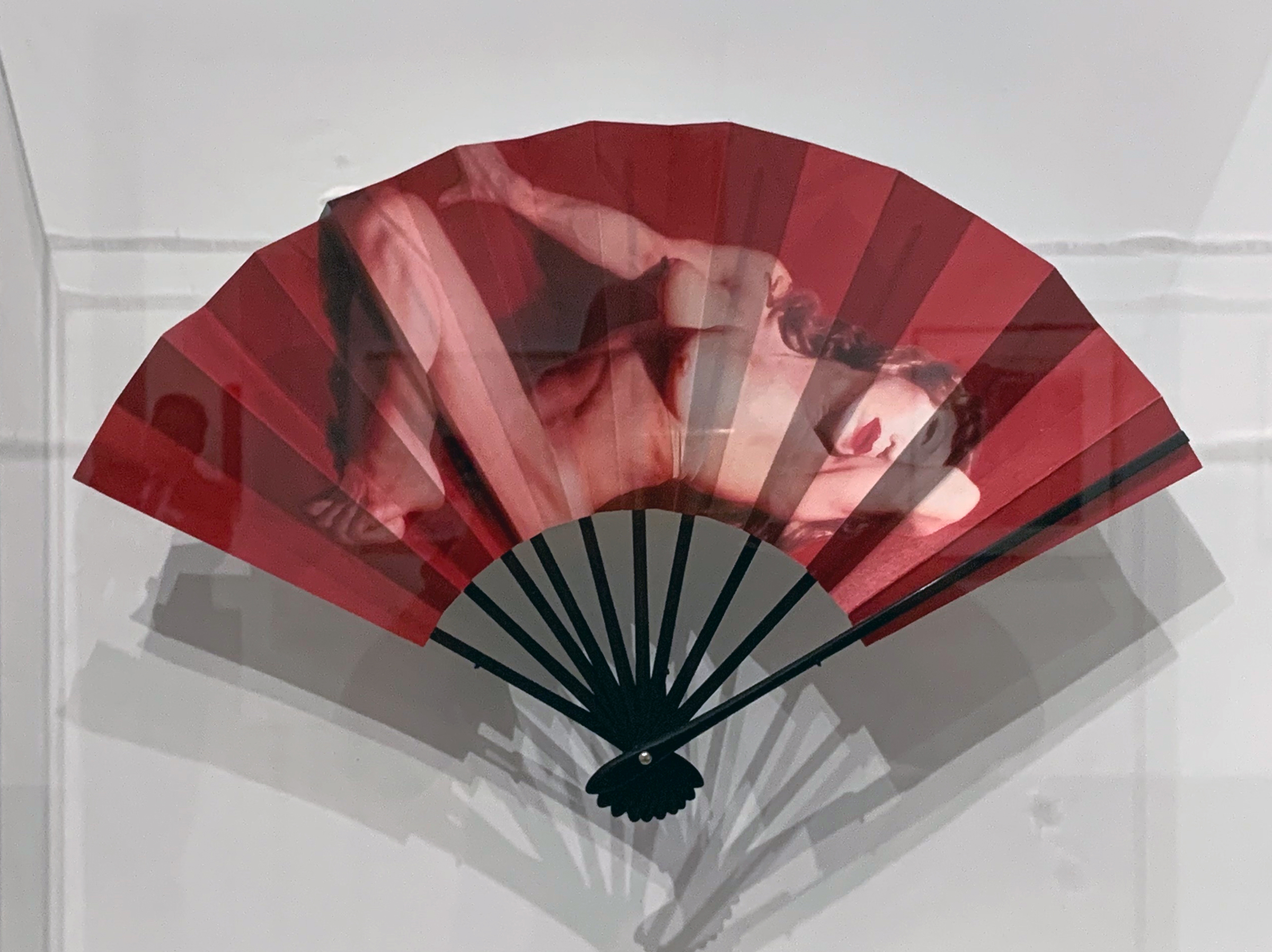
Some of the cleverest or most emotionally charged imagery in the exhibition can be found in performative self-portraiture. Tseng Kwong Chi humorously celebrated his “otherness” by posing in front of famous sites in a Mao Zedong costume, while Yasumasa Morimura portrays himself as whimsically androgynous in an image printed on a Japanese fan, an ode to his heritage. More somber in tone, yet no less politically powerful for it, is David Wojnarowicz’s “Untitled (Face in Dirt)” (c. 1990). Shortly before his death from complications of AIDS, Wojnarowicz photographed himself immersed in dirt with only a portion of his face exposed, simulating a death mask. While the artist was literally dying at the time, his self-portrait also remains a potent reminder that the government was then burying the AIDS crisis itself in the sand. Ultimately, Queer Lens reveals how the concept behind “gay pride,” a term popularized in the early ’70s, was expressed through photographers’ ingenuity long before that time, and continues to be a driving force underlying queer visibility, dignity, and self-expression.


Queer Lens: A History of Photography continues at the Getty Museum (1200 Getty Center Drive, Los Angeles, California) through September 28. The exhibition was curated by Paul Martineau.