
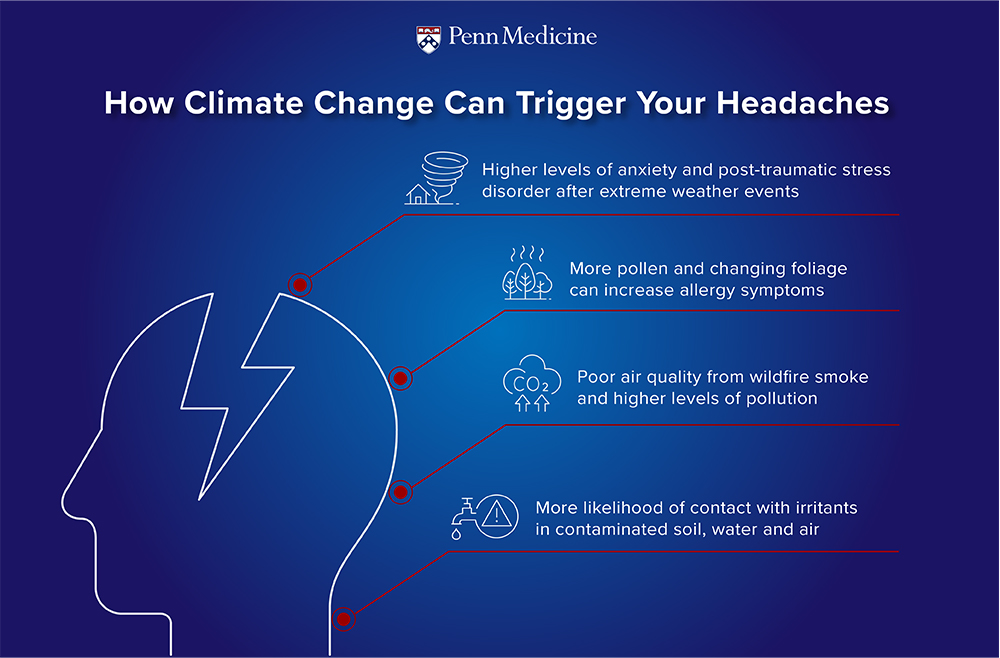
Recurring headaches are one of the most common nervous system disorders, with an estimated 45 million, or one in six, Americans complaining of headaches each year. People who experience headaches or migraines regularly are probably familiar with different triggers for their headaches—such as consuming alcohol, increased stress, or changes in sleep quality. But what people suffering from headaches might not realize is that climate change can have effects on headaches.
How Can Climate Change Cause Headaches?
According to the Environmental Protection Agency, rising global average temperature continue to impact widespread changes in weather patterns, and extreme weather events—such as heat waves and hurricanes—are likely to become more frequent or more intense. Experts suggest that the stress of these events can trigger headaches.
“Not only can experiencing an extreme storm itself be stressful, but the aftermath, where we have to deal with injuries, destruction to our homes or other property, and the loss of our possessions can add to that stress said Marilyn Howarth, MD, an adjunct associate professor of Pharmacology at the University of Pennsylvania Perelman School of Medicine and director of the Community Outreach and Engagement Core with the Center of Excellence in Environmental Toxicology (CEET). “This stress can cause people who are already susceptible to headaches to experience them more frequently or more acutely.”
With the increase of weather events that cause flooding, like hurricanes and other intense downpours, there is also an increased likelihood that storage facilities for chemicals and other hazardous materials may be disturbed, which could cause spills and leaks that can contaminate the soil, water, and air.
“A number of common chemicals, like solvents, are known to cause irritation in the nose and throat, and headaches, and if a high enough concentration of these chemicals makes it into the soil around our homes, or into our drinking water, exposure can cause headaches in some individuals,” Howarth noted. “Individuals may also come into contact with contaminated water while attempting to access their homes or evacuate the affected area, which could trigger headaches.”
Research also suggests that rising temperatures associated with climate change have an impact on changing foliage and pollen in some areas.
“These changes can lead to an increase in pollen that already exists in an area, or the introduction of a new kind of pollen in an area that has never seen it before,” Howarth elaborated. “People with existing allergies may see them get worse, and people who never experienced allergies in the past might develop them.”
A recent study from Holly Elser, MD, PhD, a Neurology resident at Penn Medicine, illustrates an increase in emergency department visits for patients diagnosed with headaches following wildfires in California. “Wildfires are most common in the Western U.S., with climate change driving the intensification and length of wildfire seasons. But even Mid-Atlantic states like Pennsylvania and New Jersey are subject to the effects of wildfires,” Elser said, noting a “red flag” warning in the Philadelphia region, just last month, resulting from warm temperatures, combined with very low humidity and strong winds, caused an increased risk of fire danger.
What Should Patients at Risk for Headaches Know?
Elser recommends that patients who experience headaches should monitor how they feel, noting whether their symptoms worsen on days when air quality is poor.
“It is easy for individuals to monitor air quality using the weather app on their smart phone, or online with the National Weather Service,” said Elser. “If there are high levels of smoke, pollution, or pollen, patients should avoid going outside on those days as much as possible if they know their headaches could be triggered.”
What Role Can Health Systems Play?
Both Elser and Howarth emphasized the importance of recognizing that changing weather patterns can cause or make a lot of types of health conditions worse, not just headaches. Research shows that pollution associated with climate change can lead to poor sleep, asthma and other lung conditions, like chronic obstructive pulmonary disease (COPD), and increased rates of cancer, and that experiencing severe weather can cause anxiety, depression, post-traumatic stress disorder, or other mental health disorders.
“In the short term, it’s important for clinicians and health systems to anticipate an increase in visits complaining of headaches or other associated symptoms, following climate events like wildfires or flooding,” said Elser. “Neurologists who treat headaches and migraines should be sure to consider environmental triggers and risk factors when counseling patients, especially if they are in areas that are impacted by increased wildfires.”
Recently, Penn Medicine has partnered with the Children’s Hospital of Philadelphia (CHOP) to create the Philadelphia Regional Center for Children’s Environmental Health (PRCCEH). Funded by the National Institutes of Health, PRCCEH aims to identify and protect the health of children in Philadelphia from many environmental threats and health problems, such as asthma, lead poisoning, air pollution and toxic chemicals and promote and harm reduction and reduction of exposure to endocrine disrupting chemicals.
Children may be particularly susceptible to climate change impacts such as increased air pollution exacerbating asthma and flooding redistributing chemicals and causing mold growth which can also exacerbate asthma.
“In the long term, it’s important for everyone to be aware of the impacts of climate change on human health, and take action to prevent and manage these big climate events,” said Howarth. “The more we understand all the ways climate change impacts our health, the better we can proactively develop strategies to care for folks who are impacted as these events unfortunately become more common.”
For more information on PRCCEH’s resources and programs, visit: https://prcceh.upenn.edu/