

By Abby Alten Schwartz
You’re an emergency department (ED) nurse on a hectic Saturday night. A patient has been waiting for hours to be seen. He’s in pain, but a dozen people ahead of him have more urgent needs. Suddenly, he’s shouting at the staff, demanding attention, and is heading directly toward you. What do you do?
Or … You’re a unit clerk in the trauma center where a stabbing victim is being treated. The patient’s family and friends are in the waiting area, visibly agitated. Another wounded patient is brought in—you learn it’s the first patient’s alleged attacker. As more people crowd in, tensions grow, and voices rise. Should you call someone?
Or … You’re delivering a meal tray on an inpatient unit. When you enter the room, the patient gets out of bed, starts yelling obscenities, and shoves her tray table against a wall. She’s now between you and the door. What’s your next move?
Working in a hospital setting today requires more than situational awareness. The sobering reality is that health care workers need special education and skills to safely navigate threatening confrontations with patients and visitors.
That’s why a growing number of employees at Penn Presbyterian Medical Center (PPMC) are being trained to de-escalate situations like these.
Protecting health care workers from violence is a system-wide commitment. Penn Medicine has invested more than $28 million to install Evolv weapons detection systems at 16 health system facilities, including all PPMC entrances, among other efforts such as expanding the distribution of duress badges to staff and a mandatory online training module about preventing workplace violence for all staff, regardless of role.
The de-escalation training at PPMC is one of the latest expanded aspects of that commitment. As of January 2024, all newly hired nursing staff (including nurses, certified nursing assistants, unit clerks, and technicians) throughout the hospital receive de-escalation training as part of their orientation. The class is also open to any other staff member who wishes to attend, as part of the hospital’s commitment to workplace safety.
Through a four-hour, in-person class, staff learn strategies to prevent conflict and injuries in the workplace. Participants are taught to identify verbal and nonverbal signs that a person’s emotions or behavior might be intensifying, and how to prevent things from escalating further. They learn to physically position themselves, allowing enough space to react to a threat or escape if necessary.
“A lot of it is about mentally preparing them for these events when they’re in a calm state, so that when things happen, they can act and go through the proper steps,” said Brian Hall, MBA, BSN, RN, clinical nurse educator for Nursing Practice and Education at PPMC, who helps teach the course.
Instructors and staff also talk through various scenarios that workers could face on the job. “The staff like hearing real-world examples from nurses of things they’ve encountered and how they handled it,” Hall said.
Zandria Moore, a unit clerk on 4 South, a medical-surgical oncology unit, said that after the training, “I felt better because I had a lot of questions on how to get out of situations, like what you can do to protect yourself without anyone getting hurt.”
While Moore hasn’t personally witnessed violence on her unit, she has heard patients raise their voices. “We try to calm the situation before it gets to that point,” she said.
A proactive approach to staff safety at work
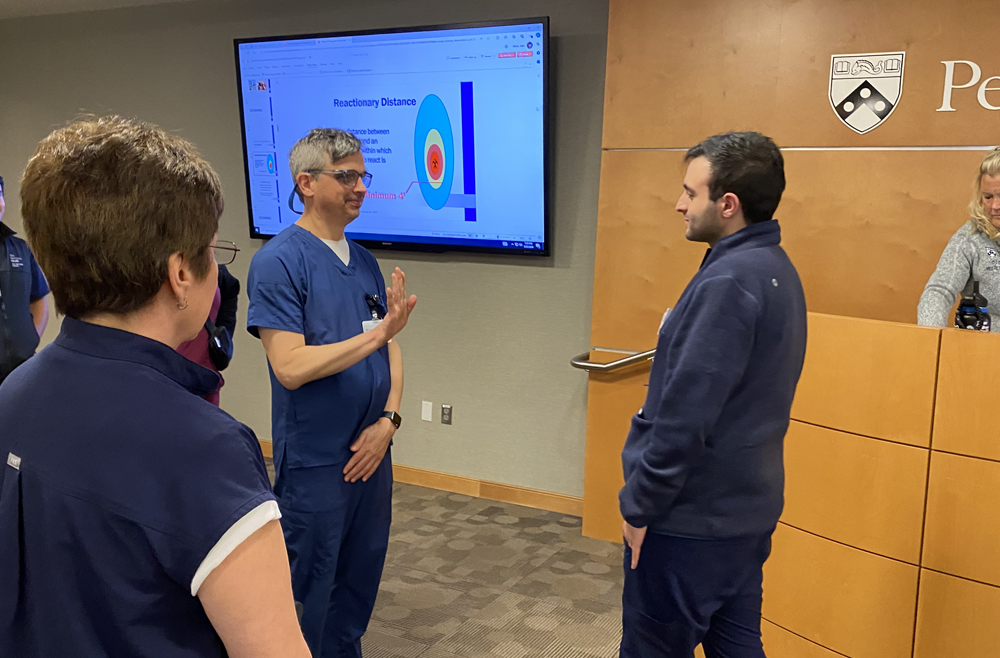
Since 2018, de-escalation training has been mandatory for all security staff plus nursing staff in PPMC’s ED and inpatient psychiatric unit. Lisa M. Triantos, MSN, RN, FACHE, clinical director, Emergency, Medical, & Behavioral Health Nursing, and co-chair of PPMC’s Workplace Violence Prevention Committee, said that in December 2022, a dozen more staff were trained to serve as course instructors. The following year, they taught four classes a month and trained more than 300 nursing staff and many others. The response has been encouraging.
“We recently surveyed PPMC employees about workplace violence, and 54 percent of those who attended de-escalation training in 2023 either agreed or strongly agreed that the training made them feel more equipped to safely de-escalate a situation,” Triantos said.
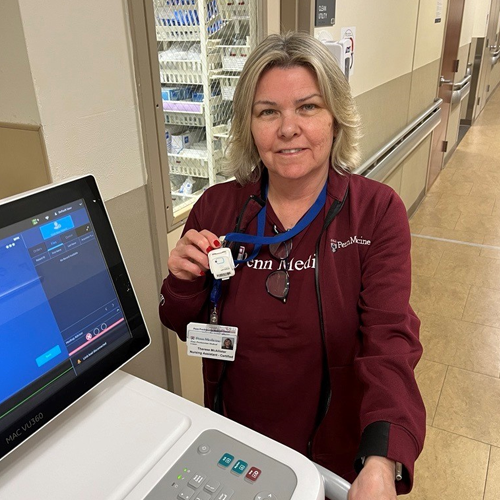
De-escalation training is one of several enhanced safety measures PPMC has adopted to help employees feel protected and supported. A growing number of staff at PPMC and other Penn Medicine locations have duress badges that let them call security without picking up the phone.
Yaya Diakite, PPMC’s director of Security and Ambassador Program and co-chair of the Workplace Violence Prevention Committee, said he sees the duress badges and the de-escalation training as tools to be used jointly.
“We emphasize the need for staff to utilize Security instead of trying to handle difficult situations alone. The duress badges represent an immediate method of communicating with Security, which will bring them to you quickly,” he said, adding that de-escalation training is “a backup tool until Security arrives. It’s a great skill to have.”
The committee also created a workplace violence prevention website for employees and holds regular active threat drills. There’s even an app to connect employees who commute by public transportation and want to travel to work together.
A commitment to communication, learning, and healing
Workplace violence has increased across the health care industry since the start of COVID-19 pandemic and hasn’t let up. Violence against health care workers can involve anything from aggressive language—including threats, racist slurs, and sexual harassment—to physical assaults.
A study of aggressive events by patients and visitors toward staff at five inpatient units at hospitals in the Northeastern U.S. was published last year in The Joint Commission Journal on Quality and Patient Safety. Findings revealed that hospital staff members experienced 1.17 verbal and/or physical acts of aggression during every 40 hours they worked. Events occurred more often when patient counts were higher, and 75 percent of incidents were managed with verbal de-escalation.
In addition to providing staff with tools and training for better workplace safety, leaders at PPMC want employees to know that they hear their concerns and are committed to maintaining transparency and open communication.
Triantos explained that one way PPMC does this is through its debriefing process. In the event of a threatening incident in the ED (a high-risk area for aggression), any ED staff member can submit an online report and the department’s on-call administrator will be notified in real time.
Within 24 hours, that administrator will reach out to the victim by phone to check on them, talk about what happened, and link them to any resources they may need, such as the Employee Assistance Program for mental health support.
To ensure that everyone understands the protocols to follow in these events, the department documented the roles of the ED charge nurse and attending physician and created an information sheet for staff that explains what to do if an employee is injured, where to access mental health support, and additional resources.
Triantos emphasized, “It’s important to check in with the employee to make sure they are okay and feel supported.”
While PPMC had already been debriefing ED staff informally, Penn Medicine instituted the debriefing process as standard policy at all of its Philadelphia EDs last year, including PPMC’s.
PPMC’s workplace violence strategies require a collaborative effort between staff from security, administration, nursing, and other departments, Diakite said.
“To create and maintain a safe environment, there must be buy-in from everyone. While we have our policies and procedures, it is vital to engage our staff and establish a space for them to tell us what will and will not work,” Diakite said. “Teamwork is a win-win deal.”
Read more about Penn Medicine’s system-wide commitment to workplace safety from University of Pennsylvania Health System CEO Kevin B. Mahoney.